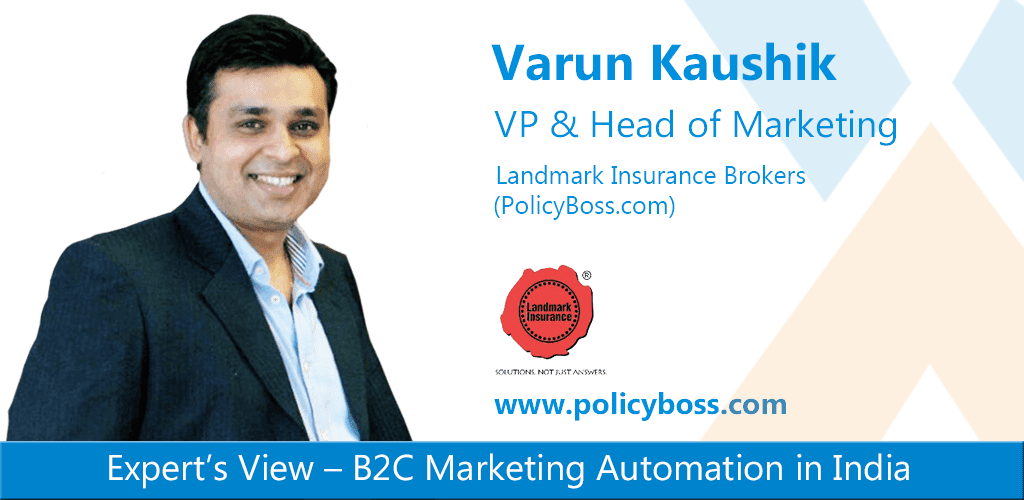
In just three years of going online, PolicyBoss.com's track record of providing free and competitive online insurance quotes has created a benchmark of its own, thanks to its user-friendly website. Varun Kaushik, VP and Head of Marketing at Landmark Insurance Brokers (PolicyBoss.com), gives useful insight about which marketing automation tools work best in the insurance industry, in an interaction with Santosh Abraham, Founder and Lead Analyst at Research NXT.
Being in charge of the omni-channel marketing strategy formulation and execution, involving tenets of channel specific marketing for its contact centre, branches, corporate and web channels, Varun is in a unique position to explain how marketing automation is benefiting PolicyBoss.com.
Marketing automation in India is still looked upon as an expense that is not giving the right returns. It needs to be treated the same as an investment.
Please tell us about PolicyBoss and its core marketing team structure.
PolicyBoss is the web identity for Landmark Insurance Brokers. Landmark Insurance Brokers is one of the largest brokers in the general insurance category. We are the front runners in general insurance with more than 3.5 lakh individual clients and 1,500 commercial clients. We started in 2002 with a single office in Ahmedabad and now we have a presence in over 20 locations pan India, in addition to the online presence in the name of PolicyBoss.
We are a team of five core members, comprising specialists in the field of content marketing, digital marketing, campaign marketing, PR and communication. Then there is an extended team of coders and web developers. Since web integration is the norm of the day, this extended team works closely with the core members.
Which is the most preferred channel to reach out to this big customer base?
Every segment has unique marketing requirements. Business wise, the most profitable channel for us is the contact centre, which is all about predictive modelling and post recon analysis. For this we use our own tools, because the sensitivity of data is so high that we cannot afford to expose this data to anybody. We have built up this data over the last 13 years and to secure it we have invested in our own analytical tools.
For contact centre and online customers we do a lot of email marketing and drip campaigns. We have a home-grown tool for this now but will soon be moving to a commercial product. We are venturing into contact centre automation: by this we will be able to unify all channels into one and will be merging our CRM and marketing automation into the contact centre automation. Once this is done it will become a seamless solution with which we can not only run business, but also obtain analytics and even schedule our marketing communications with customers and engage with them on a periodic basis.
Are you planning to implement any social media listening tools in your current business?
It is not in my top priority given the nature of business here. Social media is more of a door opener than an influencer when you talk about insurance purchase decisions. For me, SMS works more than any social media tool or email. In the B2C segment there is too much clutter in the email space. I have seen better lead conversion with a 160 character SMS than a 500 word mailer. I think the reason for this is that SMS is easy to consume, remember and act upon. The angle of convenience and simplicity works with SMS.
For SMS marketing, are you using any product which is available in the market?
We have contracted with one service provider, which is largely a volume based set-up. There are prescribed best practices and regulations that control the nature and extent of SMS marketing, which we follow diligently. The nature of SMS varies from being a standard do-not-reply set, to short codes, to a missed call driven set. The key to SMS marketing is a calling database, its accuracy and contactability.
What are the other marketing tools which should be explored for the insurance industry?
I will put it this way: what comes on the smaller screen should be prioritised first, and what comes on the larger screen comes last. Mobile exclusive products should be given importance today, followed by online and then by offline. Consumers still relate to offline channels. Since this is a high involvement product category, customers would want to experience it before taking a call. That is where the need for assisted sales comes in.
Insurance is one of the most underplayed, misunderstood and misinterpreted industries in India, personally speaking, and people still have all sorts of notions about it. While digital will definitely play a big role in educating the masses to be more aware of their options, I still foresee offline as the larger buying channel for at least a decade more, purely given the high involvement nature of the product category. Also, while digital adoption may increase significantly, in no way is that indicative of the channel being more preferred from a purchase point of view.
And that is where marketing automation has its role cut out in this industry, where it is still in a stage of nascence. In the age of information overload, one needs to assess the degree of fit for a tool with respect to its end objective and take a decision accordingly. Lead nurturing, and tools which enable it, is a subject matter that insurance as an industry can best make use of, but there are very limited options available to choose from.
What do you think is the current understanding of marketing automation in India?
There are very few people in the country who understand the true meaning of marketing automation. For many, marketing automation is just scheduling email delivery and getting a report on that, or just measuring ROI based on initial input and campaign performance. In reality it is much bigger than that.
There are two breeds of marketer. One is the technology savvy marketer who comes from the B2B segment, to whom, when you talk about marketing automation, their de facto choices are more established names like Marketo, Eloqua and HubSpot.
Then there is a completely different category of marketer who comes from the B2C segment, for whom marketing automation is a thing of the past. These are companies like Flipkart and MakeMyTrip, or any of the new age companies which have gone way beyond marketing automation. These companies have customised the algorithms according to their requirements.
Personally, India is a great testing ground, as here multiple buyer personas across all possible product categories abound. Marketing automation in India is still looked upon as an expense that is not giving the right returns; however it needs to be treated the same as an investment. And like any investment, one needs to balance out the risk factors and build on insights from both internal and external customers, to make the overall experience as interactive and rewarding as possible.
What do you expect out of this report on marketing automation in the B2C segment?
I am a former client of some MNC majors in this field and the amount of client-based literature these companies publish is huge, but these are restricted to their users. There is no report on marketing automation published in India which defines what is prevalent today, what the popular choices are and what the top recommendations for action are. Everybody will tell you that it is there in the market, but nobody would know how to start. If you are able to summarise the entire report into a 90 day action plan, then it will be something which everybody will appreciate.