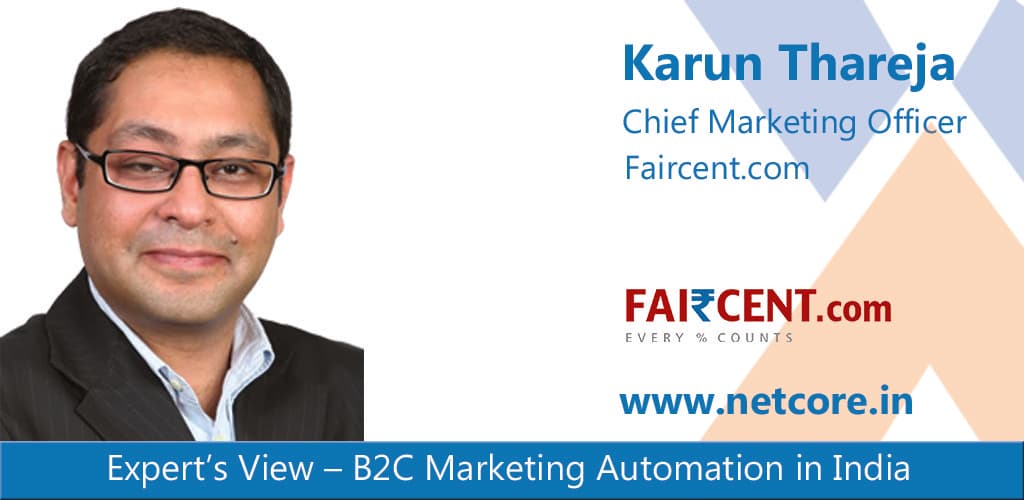
Research NXT is in conversation with Karun Thareja, CMO of Faircent.com, India's largest peer to peer lending platform. Managing businesses related to information technology has been a special focus in his career, and so his insight on how the unique offering of Faircent is leveraging the power of marketing automation makes for some interesting reading.
Marketing technology has reduced our cost per lead to almost a tenth.
The business model of Faircent is something which is new to the Indian market. Please tell us more about the company and your journey along with its growth.
Faircent is a FinTech innovator. We are basically a part of the financial technology disruption which is happening in the country today. What we are trying to do is to create a peer to peer lending industry. Fundamentally we are providing an alternative to banking and other financial institutions.
We match people who need money to people who have surplus money to invest. So you can come to Faircent to apply for a loan and also to invest in loans. Investors, whom we call lenders, can get returns of up to 18 to 20 per cent per annum, which is much better than other options today. As a borrower you can avail unsecured loans at much cheaper interest rates. What we feel is that the banks make huge margins in terms of the rates they offer customers on their savings and the rates they lend it out at in the form of loans. By reducing the margin, with Faircent as the matchmaker, we are able to pass value to both sides of the table, to borrowers as well as lenders.
We have been in operation for the last two and a half years. Today there are 15,000 people applying for a loan every month on our website, and we have 1,000 people registering as lenders every month who want to give money as loans to people to make better returns.
Where have you implemented technology at present, from a marketing standpoint?
We are purely a digital entity. We are trying to use technology so that there is minimal offline intervention. As a pioneer, we built a platform which did not exist. So we had to build a platform which enables matchmaking between the loan seeker and lender, from scratch. As a result of this, all our marketing interventions or marketing technology interventions are tied to our platform.
How we go and choose the various different marketing technologies for implementation is important for us, and we put a lot of effort behind evaluating the options, because the effort in terms of implementation is high for us compared with what it would be with a standardised core platform.
We have done a lot of marketing technology interventions. We have a CRM which is built on top of our platform, a custom made CRM, and we have integrated it with our lead generation channels. We have an email marketing platform using which we nurture our customers and also do promotional activities with potential customers. We have done a lot of work in trying to become omni-channel. The three main channels which we use are email, SMS and voice.
Going into the future, we are looking at how we can use chatbots to service our customers, and will look at getting psychometric data for our customers in order to assess whether they can be given a loan or not.
For marketing technology are you using any off the shelf products as well, or are you a strong believer in building it up yourself? Which are the products that you are using?
I think it is not about having an edge, but more that it is a requirement now. I have a background in IT where I have worked with companies like Microsoft and IBM, and what I have seen in my past experience is that CIOs do not have the ability to understand MarTech. They are good at what they do, but this is an area where there is a lot happening and it is very difficult for them to keep track. So they do need that input from marketing, and when you are talking to a CIO you have to talk technology, otherwise they will not understand what you are saying. They will always tend to look at it from the technological perspective.
You have mentioned that you are using a mix of off the shelf and in house built products. Did you ever evaluate a complete suite of marketing automation solutions available in the market which could do all that you are doing by integrating multiple products?
Mostly it is got to do with where your organisation is. Obviously, in order to take advantage of all the progress which is being made in the marketing technology sphere you need to be more open, and you can be more open if your core system is an off the shelf, standard product. But for us the key thing was that since we are a pioneer digital P2P lender, we had to build our core platform from scratch, and to take advantage of marketing technology we have custom integrated with a bunch of off the shelf products. It makes sense to develop what is core for you as an organisation, but you should take advantage of these off the shelf products as well.
From a future perspective, are you planning to invest more into mobile apps?
Yes, we have a mobile app which is available on the Android and iOS platforms. Right now our focus has been more on enabling our customers to access our platform on the mobile device. So for example, if there is an investor who wants to invest in loans on the fly, they can do it using our app. At present we are not really focused on the app to acquire more borrowers or acquire more investors and lenders. In the future we surely will run app install campaigns as well.
Is your product more focused on India as a market, and does that require a lot of customisation versus building a product for a different geography?
Our product is actually built for the Indian market. We are basically in the financial services space and there are a lot of regulations and legal structures which we need to be aware of and compliant with to be able to do our financial services business in India. The Indian financial market is very different from the rest of the world. You could sell a loan to somebody else in other countries, which is not really allowed here in India at the moment. This is the reason why we had to build a platform from scratch based on the Indian process framework.
Of all the marketing initiatives, which are the channels from where you are getting your maximum inbound leads?
Over the past quarter we have been focusing on social a whole lot, and whatever effort we are putting in there is giving us great returns. So that is a key piece of our strategy. Facebook is giving us a lot of visibility, because of which a lot of people are coming on to our platform and registering and asking for loans. We have also integrated it now with our platform in real time, where customers can get a call within a couple of minutes of coming on to our platform and registering. Currently social is bigger than search for us.
What is your advice to somebody who is evaluating marketing technology?
I would say, whatever you are doing, ensure that you are measuring it. You should measure it in terms of impact and effort. We have a saying at Faircent that it is good to fail, but fail fast. If your measurements are not in place then you will be putting in more resource than is required. Today, with the technology which is available, it is not difficult to get metrics in place. I would like to tell marketers to experiment a lot. At our level there are six or seven experiments going on in a day. We are constantly trying new things. With metrics in place you will know what is working and what is not for you.
What are your expectations from the B2C Marketing Automation Report India, 2017?
With this report I expect that my knowledge about marketing technology tools will get expanded. I would like to know more about the tools which are available in the Indian market. And it will be good if you can break down the MAS features. This will help in understanding which tool is suitable for which platform.