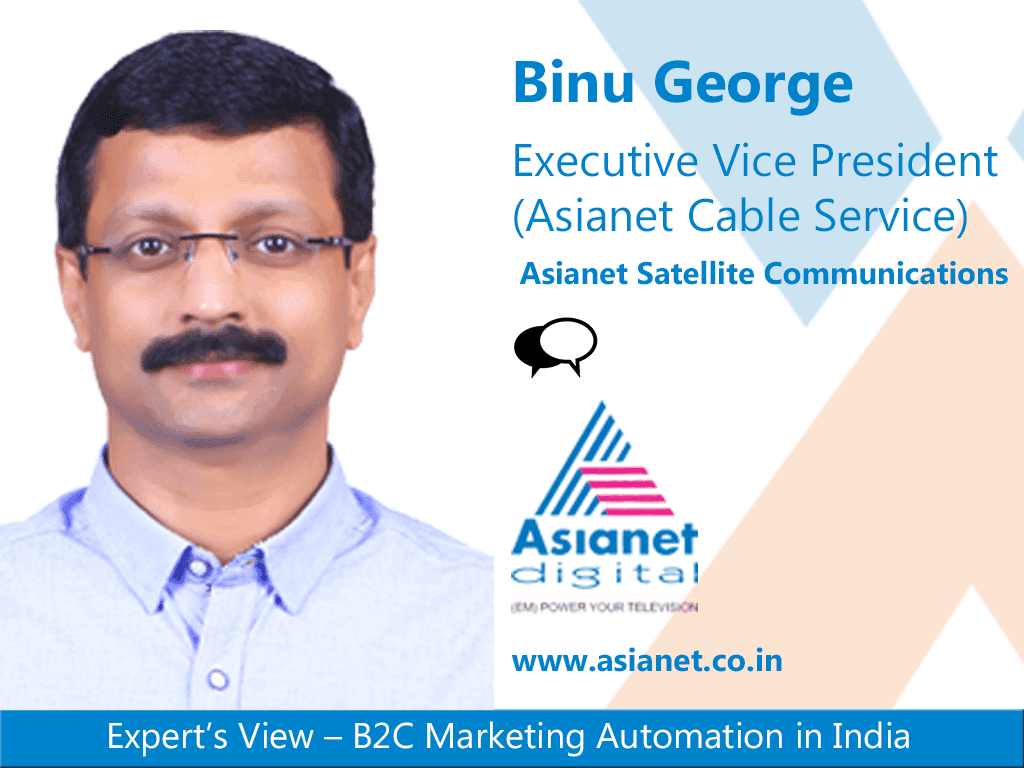
Binu George, EVP at Asianet Cable Services, during his conversation with Santosh Abraham, Lead Analyst at Research NXT, talks about the dynamic nature of the cable industry. He also explains how new TRAI regulations are going to change the complete structure of the TV cable industry, and how marketing automation is going to play a vital role after that.
Payment automation is a beautiful thing that has happened to every industry.
What services do you offer as Asianet Cable Services?
Under Asianet Satellite Communications Ltd there are two main businesses which run in parallel. One provides digital cable service; in the digital world it is called the multiple system operator, that is the distribution of channels in the digital environment with all the latest TRAI regulations. The other main business is HD broadband, which is basically like any other internet service provider. We are a 550 crore company as of now in Kerala.
What is the reach of your services? Are you providing services only in Kerala or across the country?
Right now I would say 95 per cent of our business is in Kerala. We expanded to Karnataka at the end of 2014 and also launched in AP and Telangana a year back. It is the same MSO business we do in these states, and soon we are planning to start our internet business there. We have a pan India licence for both these businesses.
What is the overall consumer base for your services?
We have a customer base of 15 lakh for cable and 2 lakh plus for broadband.
Which are the channels that you use to reach out to this huge customer base?
We are using television, radio, print, outdoor and online channels to reach out. So practically we are using almost all the channels which are available.
Of the digital platforms that you mentioned, which one is the most effective?
For online we keep experimenting with the help of a vendor. We got into online advertising a year back. We have observed that these ads are reaching customers, but there is no major increase in the lead base or conversion from there. So we do online quite a bit, but as of now the effectiveness is a little low.
Are you using any sort of automation tools at your end for emailing and SMS, or is it managed by vendors and agencies?
We have an SMS tool for the operations side but not for marketing. For example, if someone pays the cable operator then they will get an automated thank you SMS, which is an operational SMS. But marketing related SMS are purely manual. When we decide to send SMS to so many lakh customers to update them about the plans or about upgrading to HD, those are purely manually planned and there is no automation.
Have you developed any mobile app for your customers?
We do have an app, but again not for marketing. It is used for lodging a complaint or making a payment, and for our associates to register CRM subscribers. So the app is again on the operational side only and not on marketing. For customer sourcing we still have to start using these tools.
How are you leveraging cashless and digital wallet technology at your organisation?
We provide an online facility to cable customers. We have an app for customers to pay online and it is very easy to use. The customer just has to put in their ID and password to know the due amount and pay on the spot. It saves a lot of man hours and complications: if someone comes with cash, then accounting for it, then somebody going from the office to the bank to deposit the cash. We can bypass so many steps. This payment automation is a beautiful thing that has happened to every industry.
As a customer you expect the newspaper man to come to your door to collect the billed amount, and it is the same thing that people expect from a cable operator. There is a huge mindset change required for a cable customer to move from that mode of payment to online. We have been trying for the last two years and we are progressing every month by giving offers and so on, so that we can get a lot of error free accounting and the customer gets the benefit too. If I talk about the Kerala scenario, the online system of cable payment is very low among any operator.
Is the model the same for both DTH and cable in terms of a la carte?
No. Cable still means 200 to 300 channels and there is a fixed monthly rental, whereas DTH has been the same for the last ten years. The new regulation which was released by TRAI on 3 March says that all platforms, whether it is DTH, or an OTT platform like what Jio is giving, or HITS, should have a similar way of operating and similar kinds of offers and rates. So no segment or industry should have an advantage or a disadvantage as far as channel distribution is concerned.
With that, everything will be the same and the conventional collection model and marketing model will not work. It will completely stop and start afresh. So if you do this research some six months later, the cable industry will give you a completely different input. Everyone will have the same rate, and all the pay channels have to be selected, or a bouquet of pay channels selected, at the standard rate offered. So you have to be the best in terms of the customer experience you give, your entire payment mechanism, your marketing and how you upsell.