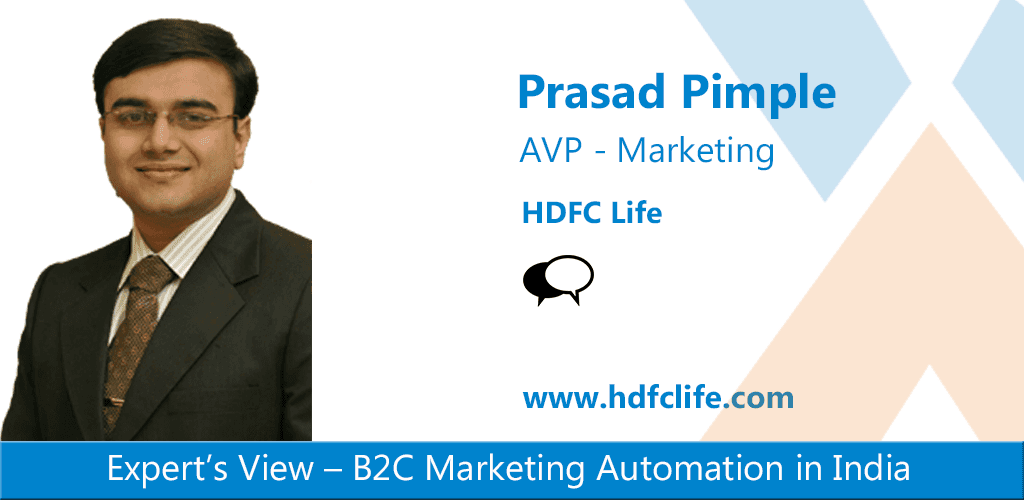
HDFC Life, one of India's leading private life insurance companies, offers a range of individual and group insurance solutions. Santosh Abraham, Founder and Lead Analyst at Research NXT, got talking with Prasad Pimple, who as the AVP Marketing at HDFC Standard Life Insurance drives the company's business objectives through impactful marketing initiatives.
As someone who is managing usage and retention marketing, Prasad shares his company's marketing strategy and the extent to which marketing automation has been successfully implemented there.
All your service systems, social media and marketing campaigns should be connected to one single system to get a unified customer view.
Let us start with your role at HDFC Life. What are the key initiatives you are working on?
I manage the usage and retention marketing function, which is all about managing existing customers. This includes how we engage and retain them and nurture the relationship.
To summarise it in a single sentence, the usage and retention marketing team at HDFC Life focuses on engagement of existing customers through direct marketing to build customer loyalty, which is used to get better impact on repurchase, renewal, revival and referral.
How do you create opportunities for tracking your customers or prospects, since the interaction rates are low?
When it comes to a life insurance or general insurance company, customers feel that companies are not interacting with them enough. Whatever interaction they are having with the company is only when they have a problem, concern or complaint. Many times customers do not even get in touch with the company; instead they get in touch with the agents through whom they would have bought the policy.
As per the Ernst & Young global consumer insurance survey 2014, in addition to policy updates, more than 50 per cent of customers expect general information from insurance companies. Customers want the insurance company to interact with them directly, they want the company to educate them about how they should go about financial planning and how they should cover risk, and they want the company to continuously engage with them. So we developed an entire plan which ensures policy lifecycle and customer lifecycle based engagement through various opportunities.
That is a good way to interact with customers. What is the size of your target market in terms of number of prospects and customers?
We have a large customer database and that itself is a huge opportunity for us. Traffic to the website usually gets converted into prospects, and for prospects you try to identify their needs and insurance products. From a data size perspective, we are talking about more than six to seven million.
How does the data flow in your organisation, and where does it reside in terms of a central repository? Is it your CRM, marketing automation, or do you have a separate data management warehouse?
We have a central data repository, which acts as the source for all the database management activities. Based on need we use it from a customer segmentation perspective and for campaign planning.
CRM is an ever evolving system. You keep connecting multiple systems to it and enriching customer level insights. You connect your sales system to CRM, then you connect your service system to CRM, then you go ahead and connect something like your social media and marketing campaigns into CRM. So it is a never ending process. You just need to ensure that more and more systems are connected to one single system to get a unified customer view. That becomes very important for you to talk to the customers, so that you do not have too many different communications with the same customer at the same point in time. So currently, if you ask me, our single customer view process is getting evolved and getting better.
If we talk about telecom, most telecom companies have well evolved CRM systems, where all the sources of data connect with the data warehouse and it is connected to CRM on a real-time basis. So there is a lot of real-time data available in the CRM. For example, if a customer's prepaid balance has gone low and we want to remind them about a recharge and promote relevant offers, we connect to the customer via SMS, USSD push notification, OBD or social media channels like Facebook. The CRM was well integrated with multiple communication channels through an automated direct marketing campaign management tool and all the data flows into it. We could also do geo-tagging in terms of where exactly the customer is, which particular tower location they are currently attached to, and for that tower location we can provide a specific offer.
The CRM that you are talking about for the telecom companies, is it an off the shelf product? It is very interesting to know that something has these kinds of features.
No. What most companies in telecom do is develop their solutions as per their needs. Here a lot of your customer data is getting added to the CRM, and it becomes very important in this case to have a strong in-house IT team supporting and developing it. The IT team will use multiple tools to achieve the kind of data integration and level of segmentation and targeting you desire.
For marketing automation, did you require any expert help in terms of implementing it, or was it an off the shelf product that you could drag and drop and use from day one?
If I talk about marketing automation for direct marketing, there are many solutions available in the market. For example, in the telecom sector many companies have used SAS as a marketing campaign automation tool. It is a flow chart based drag and drop solution, can connect with other systems and bring the database in between. You can plan your campaigns and communication via this solution. An Adobe solution is also available, which is more integrated in terms of number of channels but requires some expertise and concentrated effort to implement.
At HDFC Life, for direct marketing campaigns to existing customers, we are now using the Netcore Smartech platform for email, SMS and voice modes of communication. Before implementing a marketing automation solution, the usage and retention team was executing campaigns across communication modes by putting in a lot of manual effort. We needed an integrated, multi-channel automated platform which could seamlessly integrate all the direct marketing communication modes and automate response sharing like leads. We also wanted to reduce the manual effort involved in campaign execution.
We shared this requirement with Netcore and they worked on it, developed a solution for direct marketing campaign automation, and I think we are one of the first adopters of the Smartech solution. The single, workflow based automation platform helped us consolidate all our campaigns under one roof and saved the effort of executing the same campaign multiple times across multiple communication modes. It provided a unified view of all our campaigns, enhanced campaign performance monitoring, and automated lead scoring and sharing.
You have gone through this whole journey of identifying the right product and implementing it. As someone who has invested time in the whole process, what is your advice on the typical mistakes that people make while evaluating marketing automation for their organisation?
People should start with their own objectives first. There are solutions available in the market, but as a company we may not go for the best and most comprehensive solution. For example, if your objective is basic and small you may not go for a very comprehensive solution, because a comprehensive solution takes a lot of effort to develop and integrate with your systems, whereas a small solution could be easier to implement, easier to customise, easier to tweak around to meet your objectives. That is the number one thing: one should set the objectives for a year or two years and accordingly look for a solution which can best help you meet your objective.
Number two is, do not look for multiple solutions for your automation. It is time consuming to explore all the products and identify the best for a specific type of automation, and difficult to integrate these products. So if you have the objectives defined, look for the product which can meet all or a major part of your objectives.
The third aspect to consider is that when you are implementing a solution, you need to understand that this is going to bring a change in your existing processes and systems. Take the solution, start using it without relying on it a hundred per cent. Start implementing it part by part, not everything at one go. Do not stop all your current activities and try to manage everything via the new solution. The solution also needs to evolve and adapt to your objectives. So have some patience, and slowly and steadily migrate to the new solution. That is what I would say.