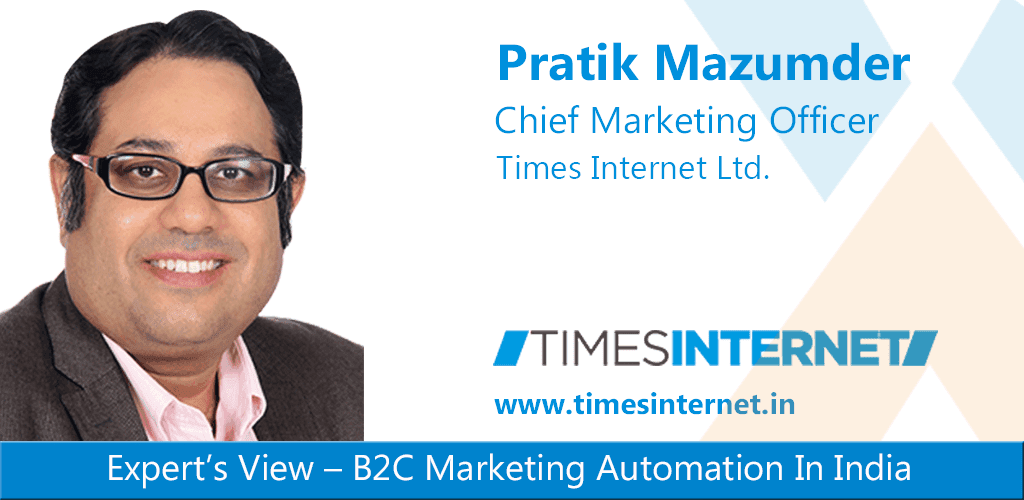
Times Internet Limited is the digital venture of the Times of India Group and is the largest online group in India. In this interview we interacted with Pratik Mazumder, who as the CMO and Head of Marketing at Times Internet Limited is responsible for the overall marketing and business strategy across all verticals, such as media and publishing, entertainment, specialty content and cricket, and consumer segments for the 30 plus brands and businesses that come under TIL's portfolio.
As someone who is driving traffic, consumer and product marketing initiatives across TIL's web and mobile platforms, Pratik gives an insider's view, in an interview with Santosh Abraham, Founder and Lead Analyst at Research NXT, on the implementation of MarTech at Times Internet Limited.
We are a technology company along with being a media company.
From a marketing point of view, where does your focus lie? Is it more into digital marketing or traditional marketing?
The Times group is an amalgamation of various businesses and brands. Most of these are in the B2C space. We use an aggressive amount of ATL marketing for some brands, and for some it is primarily digital marketing.
From an automation point of view, we primarily use Google Analytics to track spend, and others include Facebook and other Google tools. We have evaluated various tools available in the market between Adobe and Google, and in terms of pricing Google products work best for us. Other automation tools that we have subscribed to include App Annie and Apptopia to track app downloads globally and for benchmarking.
On the digital side, the various tools which are used for product marketing are for customer engagement and for personalisation. On the offline side we use very limited tools. We mainly use research based and survey based tools to track brand scores. These are embedded in our sites and we run them from time to time.
70 per cent of our total sites are content based sites like TOI, ET, language sites, and special interest websites like Zigwheels, MensXP and iDiva. Then there are sites in the entertainment space like Gaana, Cricbuzz and Dineout. Each site and business figures out what automation tools it wants to use.
Being a B2C company with such a huge subscriber base that you are targeting, would analytics play a pivotal role in planning and designing your campaign?
We are the largest media company, but we do not use off the shelf tools like CRM software to track our key advertisers and key partners, our monthly spend and to generate reports. Instead we are doing that through our own in-house ad management platform. We are the only other publisher apart from Google and Facebook who has it, and we call this marketing technology platform Colombia. We are also integrating it with other publishers, where they can run their campaigns on this platform. They can use the dashboard for native campaigns as well as regular display ads. These are not site specific but are based on special interests and are highly targeted, just the way the global platforms function.
We are getting into audience selling. There are a lot of product tools being used there. But I feel that there is a need for CRM from a tracking sales inventory and movement of key clients point of view. I am aware that NDTV and Star have a more systematic module.
There are multiple stages in the marketing funnel, from awareness and creation to qualifying a lead, making it a marketing qualified lead and then handing over a sales qualified lead, and then conversion and retention. Marketing plays an important role at each phase. Is your marketing process any different?
That would be more from a B2B angle. I think in the B2C advertising space it does not really work that way. Here the ecosystem is made up of agencies and all your clients operate via large or small agencies. These agencies get in touch with the key account managers or with the direct sales team. For instance, if Hindustan Lever wants to run an ad campaign on TimesOfIndia.com, Hindustan Lever will get in touch with an agency like Mindshare which in turn will reach out to TOI, to share a brief and to make the plan. So in the media space and the B2C space in ad sales, marketing plays a lesser role compared with a product or software solution client where marketing generates demand.
For us, marketing is not for regular inventory selling. Maybe my role would have been different if I was part of a smaller property and not TOI, and I would have focused on generating demand. But today, because of being the largest publisher in India, I do not need to generate demand. My sell-through rates are pretty high.
We do indulge in some marketing work, but those are not tools or analytics based. We have created IPs like the TOI Sports Awards, Filmfare Awards and Femina awards, which help in demand creation. Here marketing plays a role, in putting together the piece, creating demand and generating sales. But in the normal consumer space the role of marketing is negligible.
How is email marketing integrated into your business?
We have an in-house tool for email sending and customisation. It is part of our product metric, where we get consumers to subscribe. We do not spam or send emailers through a third party. People who have subscribed to the newsletter are sent emails based on customisation or the interest based targeting which they may have selected.
What is the reason that you have gone for an in-house solution instead of using available tools in the market?
We believe we are a technology company along with being a media company. This is why we decided to create our own ad publishing tool instead of continuing to integrate with the content marketing platform Outbrain. We have in-house expertise with a full team of developers working for us. All apps, websites and app designs are created internally; we do not go to a third party UI and UX design firm to help us design them. The KRA of the design team is to create the best-in-class product, and for that they work with the best tech people.
We are different from competitors like NDTV, Indian Express and Hindustan Times, where they are just a digital wing of the newspaper or the news TV channel. TIL takes pride in being differentiated, as only 30 per cent of the business is content based and the rest is made up of products which we have created or are in the process of creating. For example, the music content destination Gaana.com is not a news website but a product which we have created. Cricbuzz is the leading cricket score update app which we acquired a year back and built up. So the focus and vision of the company is to create products in house as much as possible.
Are these products only for in-house consumption or are you planning to take them to market?
At one point of time we will take them to market. For example our ad tech stack is already used by various publishers in the country, like Punjab Kesari, Amar Ujala and Loksatta, which are already integrated with our platform.
We are slightly different from the rest of the publishers, a key differentiator being that we have literally become a Sequoia in terms of the investments in this space, playing the role of a venture capitalist. I have lost count of the number of investments we have made in the last three and a half years that I have been here, at least above two dozen.
We are also the growth partners of various US based large multi-billion dollar companies that are in, or looking at entering, India as a growth market, and we are playing the role of their growth partner in India. Whether it is Uber or Airbnb or Coursera, our marketing team is helping them find the agencies, developing their communication and rolling them out. So we are running like a mini agency out here.
Any predominant challenges that a media house like yours faces while rolling out technology when it comes to marketing?
When we launch a new product, the biggest challenge which we face is scaling up. And in India a huge amount of investment is required in marketing. So how to scale up at the lowest possible cost, to be able to get the ROI, is the biggest thing that a marketing practitioner is grappling with today.
Organic demand is good at the initial stage of testing a product; after that you need intensive investment to scale up. That obviously leads to a lot of pressure on the bottom line. It requires deep pockets to really be able to scale up. Scaling up through organic or through social media can be done only up to a certain extent.
What are your expectations from this report, or what insight would you want about the industry?
From this report I expect to get more insights on global MAS trends and, at India level, the new MAS tools being used by leading brands, their benefits and use in campaigns.