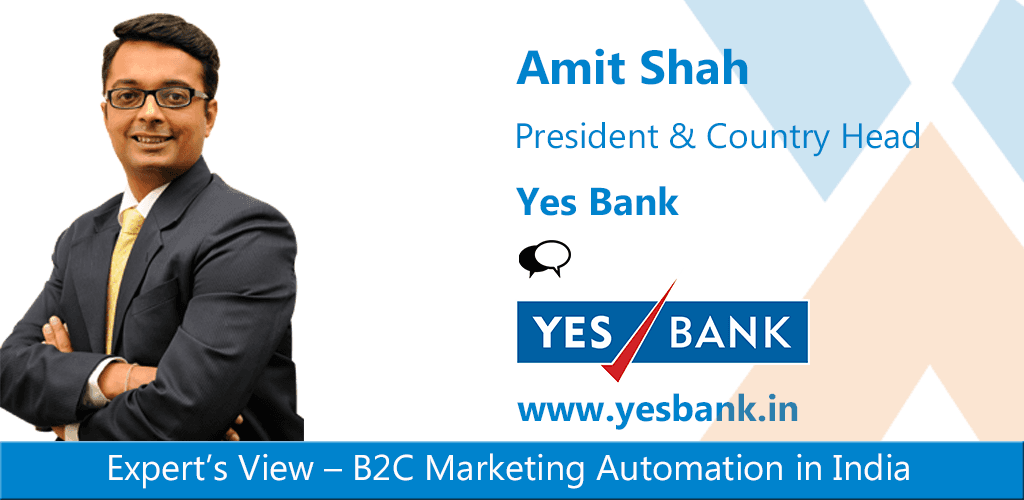
Amit Shah has been instrumental in creating and strengthening the YES BANK brand equity over the last eight years through an integrated knowledge banking approach. As Editor-in-Chief of CFO Insights, a publication catering to global financial thought leadership, he has introduced a new paradigm of inclusive public policy interactions.
In this conversation with Research NXT, Amit explains the various digital initiatives taken up by YES BANK and how they have transformed the way banking is done.
We like to believe that we are a technology company, in the business of banking.
What is the primary focus of marketing at YES BANK?
At YES BANK, the focus of our corporate marketing endeavours has been on initiatives that enable us to strengthen our thought leadership positioning, broaden mindshare and thereby deepen market share.
Consequently, we have made a conscious effort to create marquee knowledge properties as an equal partner, rather than merely providing sponsorships and logo usage. The idea is to ensure that this positioning also translates into tangible business outcomes for the bank and helps us project our strengths in key focus sectors.
Similarly, on the retail front, we wanted to create a vibrant, youthful brand, and a bank which always says yes to growth and prosperity. So in order to connect with the youth, we have consciously associated with the Indian Premier League, the country's pre-eminent sporting event. This partnership has been highly successful over the years and has helped propel the YES BANK brand to the next orbit. We also partner a number of golf and polo events, in our attempt to nurture sporting talent at the grassroots level.
You recently launched a cashless payment solution for Nashik Smart City. Please tell us more about it. Are you planning to do something similar in other cities as well?
YES BANK is committed to furthering the government's vision of a less cash economy. Digitising smart cities is a key step forward in this regard, which helps us partner with these cities and help them with technology to enable cashless payments.
We will also be launching these solutions for both the Udaipur and Puducherry smart city projects, in addition to Nashik. Additionally, we are in talks with multiple other cities shortlisted by the government for the Smart Cities Mission. Through this, we are enabling and empowering the residents of these cities to go digital and make all payments at the click of a button, in an easy and convenient manner.
YES BANK has differentiated itself by embracing world-class, state of the art technology. Do you think Indian customers are ready for technology when it comes to banking?
At YES BANK, technology and innovation have been critical mission pillars since inception. We like to believe that we are a technology company, in the business of banking. Today consumers are agnostic to technology and are more interested in a seamless banking experience. Therefore our technology offerings are as per the needs of the different segments of these consumers.
The paradigm of creating a delightful experience is changing, and so at YES BANK we strive to create a memorable customer experience, not only through our branches but also through digital platforms offering an omni-channel banking experience. We have taken an alliances, relationships and technologies approach to digital banking, and are partnering with multiple companies to ensure that we remain on top of the technology and innovation curve.
During the initial period of demonetisation, what were the digital interventions that you enabled to reach out to your customers living in extremely backward areas?
Against the backdrop of demonetisation, in an effort to facilitate financial inclusion, YES BANK launched SIMsePAY, allowing users to make secure mobile payments using any mobile phone, across any telecom network, with the help of a wafer thin sticker that could be pasted on any type of SIM card. Before the launch of SIMsePAY, mobile banking was only available on smartphones with internet or data connectivity, while the majority of rural India remained deprived of on-the-go mobile banking. We partnered with multiple co-operative banks to ensure that this solution reached customers beyond urban areas.
We also leveraged our YES MONEY solution to help address the demand for cashless payments during demonetisation. This uses the business correspondent model to bring the transaction touchpoint closer to this set of customers, even during non-banking hours. YES MONEY has served more than 4 million customers through 44,000 business correspondent agents.
You have been with YES BANK for almost a decade now. How has marketing transformed over these years in your organisation?
As the bank evolved over the years, our efforts in marketing have evolved as well. Initially we focused on creating mindshare at the corporate level, whereas now our focus has changed to converting this mindshare into market share and helping grow the bank's business. Additionally, with the evolving consumer mindset as well as media mix, we have changed our marketing approach to cater to these consumers.
With the emergence of powerful digital media, we have tailored our strategies to leverage the strengths of these online media. For example, YES BANK has transformed its content marketing strategy and used content on LinkedIn to create strong engagement with important stakeholders for the bank, such as CFOs. Similarly, our objectives on Facebook and Twitter are different, and dwell more on communication of the bank's achievements than on detailed content.
Could you tell us more about the YES PAY digital wallet and YES TAG social media banking? Are they part of your omni-channel marketing strategy?
YES PAY wallet and YES TAG are significant, state of the art digitisation initiatives that we have pioneered. YES PAY Wallet is an initiative to facilitate payments through Facebook and smartphones. This is the first digital wallet to offer the option of chatbot banking, where users can transact on the wallet in a conversant and intuitive manner. Users of the wallet can transfer and request money to and from peers, split bills in a group, initiate mobile and DTH recharge, pay bills, get deals and coupons, purchase gift vouchers, pay for music downloads and avail handset protection. The wallet has also been integrated with multiple aggregators and merchants like PayU, Euronet, CouponDunia, One Assist, Witty Gift and Café Coffee Day to facilitate online and physical payments.
YES TAG is a first of its kind smart social banking application that allows customers to perform banking transactions seamlessly on Twitter, Facebook Messenger, WeChat, Telegram and Skype. The service is completely secure, as financial transactions need to be authenticated by a six digit social security code set by the user at the time of registration. There is also no need for users to remember any short code or commands to interact with the bot.
As a bank, we are committed to offering an omni-channel experience to our customers through enhanced digital platforms and collaborations.
What are the main challenges that you have faced while implementing or using marketing automation in your organisation?
One of the key challenges is to ensure tracking of the return on investment on the marketing effort for the corporate business, where conversion of a lead takes a longer time. A lot of the outcomes on the corporate marketing front are also more intangible and difficult to quantify. However, with the proliferation of digital channels, the idea is to use the engagement metrics and other statistics that these channels provide to continuously improve our marketing efforts.
What are your expectations from the B2C Marketing Automation Report India, 2017?
From the report, I would want to get an insight into how one should go about selecting the right system and allocating investment. It would also help to get an idea about the common features and advanced functions of marketing automation tools that financial organisations, particularly banks, are using to streamline, automate and measure marketing tasks and workflows. A couple of case studies would also be useful.