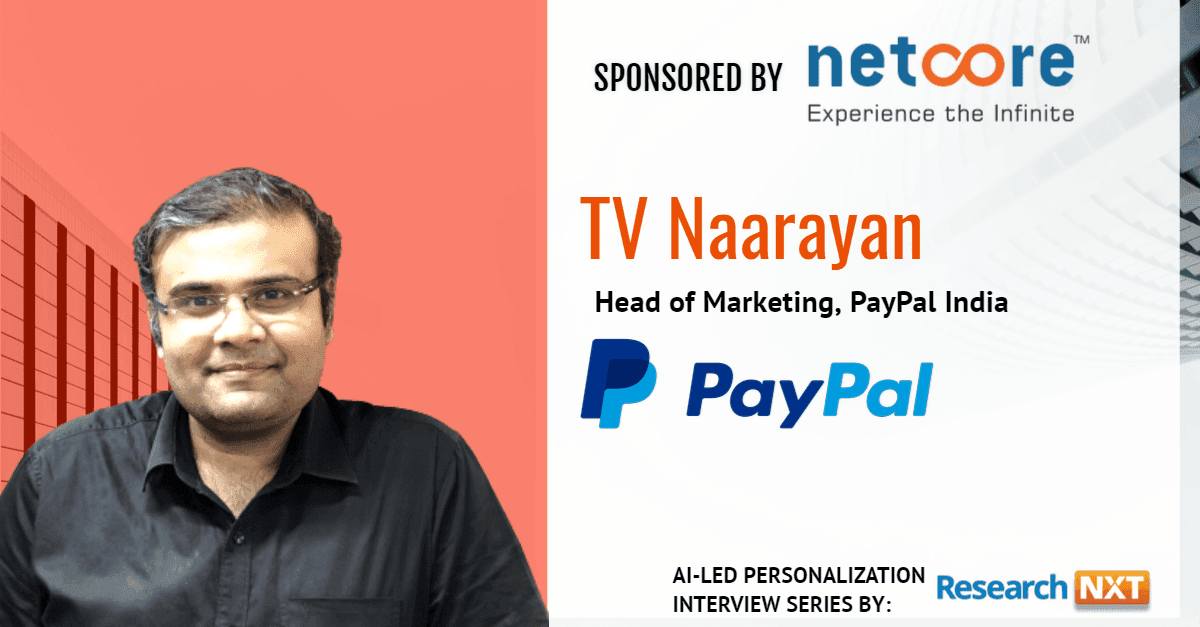
In this Research NXT interview, TV Naarayan, Head of Marketing at PayPal India, talks about how the payments space has evolved in India and how the pandemic has moved digital payments from a nice to have to an essential service.
Key highlights
What this conversation covers
- TV Naarayan's observations on the evolution of digital payments in India.
- How PayPal is using AI and data science to understand the customer and their life cycle, to pitch them the right solutions when they are looking for them.
- How digital payments have become a measure of safety, much like masks and sanitisers.
The pandemic has moved digital payments from a nice to have to an essential service.
We would like to start this discussion with your journey as a marketing leader in the BFSI space, and observations on how marketing has evolved in this space with the changing and evolving business models.
The BFSI space is in a constant state of flux and continues to evolve. In terms of semantics, we are moving from financial services to what we call fintech. About 15 years back, when digital marketing meant creating banners on websites, and having a decent website meant you were savvy, the standard of good work for most organisations was having the lead collection fields in the banner itself, the standard fields being name, mobile number and city. From those days, we have moved on to search, programmatic display campaigns, mass personalisation, and much beyond. Today, marketers are not treated as the people who do only creative work in nebulous territory. A marketer drives growth by virtue of the fact that they bring a great understanding of messaging combined with tech to drive productive conversations with customers.
Campaigns are analysed in so many ways because there is so much data out there. You can segment customers into multiple buckets and serve your audience with relevant messaging that genuinely benefits them and gives them a personalised experience.
One of the big shifts is the change in the way marketers are taking to technology and data. Right from the ad platforms we use to the central data repository that exists internally, we can pick from models that can project what is ideally suited for a customer in terms of product or service needs. In that sense, it is no more a blind push of products; it is a conversation that is constantly evolving based on how a customer reacts to a piece of communication. Increasingly marketers are looking to talk the language of full stack, DSP and DMP and more, and that is a great place to be in. In what could never have been predicted about 15 years back, a marketer today is supposed to understand technology, manage communication and develop a creative strategy. Even within marketing, this is turning out to be an age of specialists. You cannot have a dentist treat someone for eye-related issues. Similarly, conventional brand marketers may not handle, say, performance marketing. So, as a marketer, it is more choices to make, but it is also great from a learning perspective.
It is heartening to see that the models of doing business are also constantly metamorphosing from competing to partnering. If you look at the new business models, marketers have come to accept revenue sharing to be able to grow mutually, partnering on certain shared goals with players who in the conventional context would be perceived as competition. Today the biggest players in the fintech space partner with start-ups and early-stage firms to develop solutions that are great for consumers. I have always been fascinated by how aggregators and banks work together to drive reach. Similarly, how players in the payments space are able to democratise payments across different sections of society.
PayPal has been in India for over a decade, focusing on the consumer segment and the maturing digital payments market. Please share some marketing initiatives that worked for you in a market with massive competition in this space.
The truth is that the payments space in India is in the early stages of infancy. And yet, there has been so much innovation that we are ahead in payment capabilities compared to most developed markets. At PayPal, we have always believed that the race we are running is a marathon and not a short sprint. India is such a diverse market that marketing tends to feel like running campaigns across multiple geographies. There are commonalities but also vast differences; the cultural subtext of what works in one state may not work in another.
If you notice, consumers in India took to digital payments after demonetisation, but cash still reigns supreme. The appreciation that digital payments offer convenience and security was probably lost in the game of discounting the price point of goods or services. So, yes, the consumer market has a lot of players in India, which is good as the opportunity is hugely untapped, and more players mean deeper and wider penetration and more innovation.
The pandemic has moved digital payments from a nice to have to an essential service, right from ordering groceries to watching movies on an OTT platform. And this is where I think payments will see a new baseline in terms of growth. The fact that customers in India can buy confidently from the largest and also the smallest merchants from across the globe with PayPal is a testimony to the faith reposed in us. Also, our focus is on offering a safe and seamless payments experience to our consumers. We have a base that is very loyal to us, and they see us as a trusted way to pay across the globe. Our segments start with the young digital natives who pay with PayPal for gaming and ordering food, to the silver tech generation to whom digital is still new but essential in these days. What is great is that we see such unique use cases, from the working professional who uses PayPal to upskill himself on an edtech platform to the business segments like SMBs and freelancers who wish to target audiences in other countries.
At PayPal, our focus is on becoming a champion for SMBs, helping small businesses and freelancers leverage the global opportunity. It is a shining example of support local. Over the years, we have literally built the freelancing economy, or the gig economy, enabling freelancers to sell their goods and services to a global consumer base.
We see SMBs and mid-sized merchants shifting their focus to a digital-first one and hence thriving even in these very trying times. Very recently, we launched a Spotlight campaign, where we showcased and supported SMBs that have overcome challenges and built successful businesses even during the pandemic. We have been able to create awareness for these businesses and help and inspire other businesses.
Considering the scale at which you are operating, I am sure you would be leveraging AI, ML and data science to optimise your marketing and personalise user experience. Please share some use cases where you have implemented personalisation at scale.
PayPal has revolutionised the way customers across the globe pay for anything from food to fashion. As we evolve and become more efficient, and artificial intelligence learns to better emulate human intelligence, businesses benefit from the increased process and operational efficiencies. AI and machine learning are being used to gauge risk and assess fraud cases. Here, analytical tools are used to collect evidence, and data is analysed, wherein AI tools learn and map out user behaviour and seek patterns that can be used to identify potential fraud attempts. Over time, AI systems can learn and adapt to weed out undiscovered cases and refine fraud and risk detection capabilities to better protect consumers.
As far as marketing is concerned, we do a lot of test and learn. Our teams believe in the champion-challenger concept, where we put several hypotheses to test and then scale what works best. Right from having separate experiences for prospects and customers, we are able to leverage machine learning to show what is most relevant to them. Another example is how we are able to showcase the right product to the right customer segment depending on their evolution with us. For example, let us say someone whose hobby is baking cakes may want to test the waters. They are most likely to start with PayPal via email payments or PayPal.Me, which is a customised link to receive payments. At this stage, they may be new and not an established business in terms of scale. In fact, they may not consider themselves a business. However, as they mature and start seeing the scale, we are able to offer them solutions that will help them grow. To us, it is not one size fits all, and hence understanding the customer and their life cycle through data is what helps us pitch them the right solutions when they are looking for them. The same logic holds true on the retail consumer side as well.
In times of the COVID-19 crisis and even long after it, do you think digital payments will overtake the most used payment mode, cash, in India? How is PayPal helping customers and merchants adopt this shift?
COVID-19 is what we can call a black swan. The spread of coronavirus has turbocharged the world of digital payments. For merchants, moving online is existential, and it is how they will stay in business. So, for all the pain it has caused, I do think that COVID-19 will fundamentally change the way we look at payments. Payments will definitely have a new baseline in terms of growth. In many ways, the earlier generation used to write out cheques or use demand drafts. Today, you ask millennials what they are and they will only give you blank expressions. So, payments is evolving. But it is not going to be an overnight journey where, once things become normal, people will suddenly stop using cash. That will depend on a lot of factors: data connectivity, which is improving as we speak, in remote places, educating the masses on the benefits of digital such as safety and fraud controls, smartphone penetration, and the ability for payment companies to manage risk and offer customised experiences. If anything, we are seeing the older generation, or silver tech generation, also take to digital these days. That is a welcome change.
Digital payments are looked at as a measure of safety, much like masks and sanitisers, since they help conform to social distancing norms and remove the risk of handling currency.
At PayPal, we believe in enabling businesses to go online and grow by reaching a diverse set of consumers across the globe. The fact that an SME can take their business global with PayPal is a great validation in itself. What can beat the joy of seeing a young website designer or artist making a sale to someone in the US or UK. That to us is truly support local.