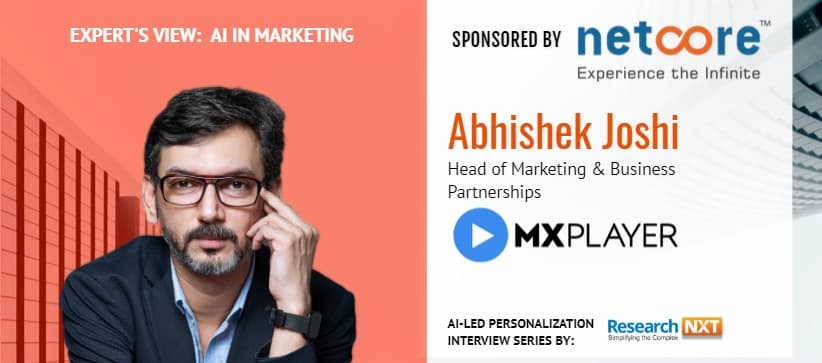
In this Research NXT interview, Abhishek Joshi, Head of Marketing and Business Partnerships at MX Player, talks about his journey of more than 19 years consistently in the media and entertainment space, and the dominant emerging trends he sees for the online streaming space in the rest of 2020 and beyond.
Key highlights
What this conversation covers
- How personalisation has significantly improved MX Player brand loyalty and helped reduce user acquisition costs, increase revenues, and improve ROI.
- His three primary use cases for any app: onboarding, re-engagement, and new feature rollout.
- His top observations for the online streaming space in the remaining half of the year.
Technology is acting as a catalyst in exploring the power of personalisation at MX Player.
We would start by learning about your background and how you came to be the Head of Marketing and Business Partnerships at MX Player.
I did not plan my journey as a marketer, but when I finished my MBA back in 2001, I landed in a media print company, the Ananda Bazar Patrika Group, out of campus placements. I started in sales, like every other management trainee, where I used to sell newspapers in circulation sales at 4am every morning in remote places of Jharkhand. So I started doing that and then advertising sales, then branding and strategy till 2011. However, one thing that has been constant in my 19 years of career is that I have always been in the media and entertainment space. I have done print, TV, sports, movies and digital. The only couple of things that I have not done are radio and gaming as yet, but apart from that, I have done almost every aspect of the media and entertainment ecosystem.
Prior to MX Player, I was the head of marketing, analytics, subscription, and licensing for the digital business, Sony LIV, of Sony Pictures. My role here is everything related to the growth of the brand and the platform, and to make MX Player the go-to destination for everything entertainment.
From a marketing standpoint, how important is personalisation in the app and the OTT platform? We would like to know more about how you are leveraging technology in your current role at MX Player, and how vital personalisation at scale is for your brand.
The journey of MX Player has been inspiring, to say the least, over the last 18 months, since we launched in February 2019 in India with the OTT streaming app. We have grown leaps and bounds, thanks to our users, who have shown immense trust and respect in the product and content offerings. Right now, as we speak, the OTT ecosystem is very highly competitive. So we are focusing on personalisation to ensure customisation of messaging and experiences to our audiences, based on their preferences and behaviour. Personalisation has significantly improved MX Player brand loyalty, helped in reducing our user acquisition costs, enabled us to increase revenues, and improved ROI.
Secondly, we have been adopting technology to capture information about the customer's needs and intentions through multiple sources to extend personalisation at scale. For example, we are monitoring social media posts, comments, likes and dislikes, and preference of genres, to automate and render customisation at scale. For us, technology right now is acting as a catalyst in exploring the power of personalisation.
Are you using AI-led content recommendations for curating and creating the programme content on your platform, like a lot of global OTT players? If so, could you shed some light on it?
Out of the many things, home page recommendation is something we care about extensively. A user is likely to spend most of their time on this page, and the maximum traffic tends to be generated here. Hence, it makes much sense to have personalised homepages for each of your users, as it improves the relevance of the content and the suggested offering, which effectively results in better engagement. These recommendations are based on multiple user attributes, like their viewing history and engagement data. We also focus on genre-specific recommendations based on real-time reading and listening history.
The other thing that we do is create personalised watch lists or playlists, which can be customised by the users. These kinds of personalisation are based on a variety of factors, such as the kind of content they consume and the propensity to consume a particular genre, which could ultimately improve the click-through rate by a considerable margin.
Thirdly, we communicate with our user base through personalised emails and personalised notifications for a better customer experience.
As far as use cases are concerned, I think there are three primary use cases for any app: onboarding, re-engagement, and a new feature rollout.
Starting the onboarding process. While onboarding first-time users, a messaging campaign is created to introduce the new users to the app and educate them via notifications to try the app features for increased granularity. Secondly, there will be some user segments from specific niches who would not be active after signing in. This segment needs to be targeted as well, to push them a step ahead.
The re-engagement initiatives. This activity targets dormant users, which can have various definitions based on the platform. These segments are the ideal candidates for A/B tests, push notifications, and email outreach with personalised approaches for bringing them back to the platform. Once they are active again, it is time to analyse the segments and see triggers for conversions, and this analytical intelligence is essential in the long run.
The new feature rollout phase. This phase involves segmenting the users who are on the older version of the app and using push notifications to coax them to upgrade the app and avail themselves of the advantages of the new features. Additionally, these users are also prompted to leave a review and rate the app on the Play Store or the App Store. We have also been focusing on onboarding offline viewers towards the online version and keeping them engaged with the video content, as we now have music and games too on the app.
I believe that irrespective of the product, the way you communicate and the way you address the user will almost be the same across all B2C business categories. What we deliver to the user who requires that particular product should be the focus. As businesses, we need to ensure that we are speaking to the right audience in a manner that quickly communicates the message in an enticing way, either through offers or any other form of marketing tactic.
Apart from the subscription-based revenue model, you also have a revenue model where you help advertisers target the right audiences through your platform. Could you share more details on that, and how you are assisting relevant ads to come to your subscriber base?
We are not yet an SVOD platform; we are a complete advertising-led platform. We help advertisers and brands leverage our massive data points in terms of segmentation and all audience inputs, which effectively helps them target better, because doing it at scale ensures efficacy in execution.
You are working with many marketers from different brands. During the current pandemic situation, what kind of marketing innovations in terms of outreach to end audiences are happening?
I would not say marketing, but a lot of advertising is happening on digital, and that is the first piece. The second piece is that the advertising is happening through video on digital, because the uptake of the digital video ecosystem has been substantial in the last six or seven weeks. And in the online streaming space, there are a few observations that I have, or maybe trends, which I think will happen this year. They are:
- Everybody knows that content will grow faster and deeper.
- Mobile will become the main channel for content delivery. That is going to happen very soon.
- Increased content fragmentation will happen due to the competition.
- OTT advertising investment will increase significantly this year. That is for sure, because an average Indian spends about five to six hours consuming online content every day. Going forward, spending per month on digital media content is expected to grow by at least 2 to 3x.
- With COVID-19 and the lockdown, the presumed growth that I had for this year has already become 2x of what was expected.
- Video-based content is becoming the most preferred content type; it has been more than 65% of users choosing it over text-based content.
And the same is evidenced in the massive scale that platforms like MX Player or YouTube have achieved in the last year and a half. Combined with the demand for video first, vernacular content has also emerged as key for the Indian consumer, which is going to be the driving force in terms of content delivery for this year.