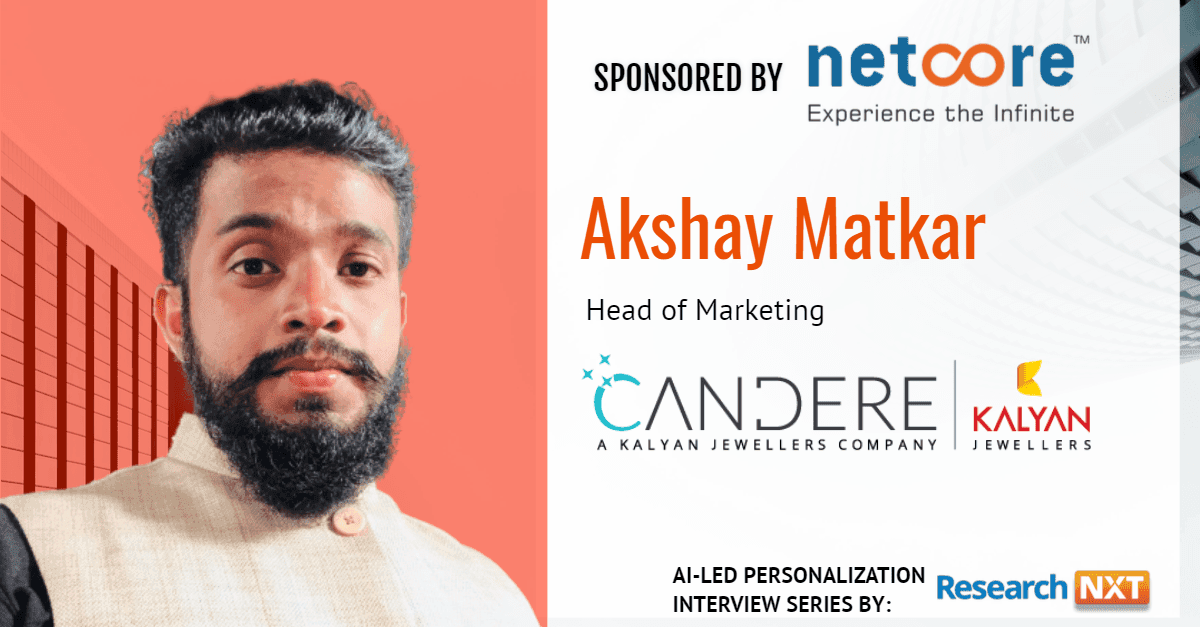
Akshay Matkar, Head of Marketing at Candere, takes us through his journey as a marketer and explains the growth strategy behind the growth of Candere as an online jewellery shopping destination. He shares the brand strategy and insights into the mindset of jewellery shoppers and establishing Candere as an omnichannel brand. Akshay discusses the merger of Candere with Kalyan Jewellers and how AI-driven personalisation is a heavy focus for their online strategy. He discusses the importance of replicating the family jeweller's personalised customer experience online, and also talks about the responses and implications of COVID-19 on marketers in this space.
Personalisation is not a trend. It is a marketing volcano which has erupted. So every marketer needs to adjust their strategy towards personalisation now; that is the new mantra.
Let us start with your journey as a marketer to a senior leader in marketing, and your role at Candere.
I come from a background in computers. I joined engineering because those were the days when everyone was doing engineering, and I followed the flow. While I was studying, some friends and I experimented with selling firecrackers online, trying to utilise our newly learned programming skills. That was in 2009, when digital was gaining popularity, witnessing the evolution of ecommerce and digital devices. During this venture, I researched deeply into digital marketing and was fascinated.
I decided to switch my career after college. I joined a digital agency, working for close to two years in a digital account manager role, handling a portfolio of clients in real estate. Then I wanted to get into the ecommerce side of the business, to explore more towards data, user journeys, and to witness the completion of funnels from top to bottom. I joined Candere in 2015 as part of the marketing team, where we were expanding and got funded. A few years later, I was promoted to manage the marketing duties. Here, I would say, I learned the art and science of marketing, along with growth and innovation for business expansion.
I took on the role of heading marketing in 2019; I was in a managerial role earlier. The entire infrastructure of marketing, building systems, setting processes, and getting agencies, I was able to witness all of it. The foundation of marketing as a whole we had to build, and I closely worked with the internal stakeholders to build up the marketing to where we are right now.
We were nowhere in the picture when I joined. Now we are in the top three. The second and third position is very competitive. We got associated with Kalyan Jewellers in 2017, and it expanded our horizons.
You are selling a very traditional product online. Are there any specific challenges you have faced that you think usual brands would not face when selling a product online?
Jewellery is a higher ticket size product. If you see the buying pattern, I would say that maximum jewellery purchases happen via family jewellers. So the experimentation is less, and there is a lot of emotion attached to jewellery. It is not just another product like buying a mobile phone, which I am not very emotionally attached to because I am changing it frequently. But there are pieces of jewellery which I am keeping for a considerable amount of time in my life, say 25 years or more. So there are a lot more emotions attached, hence convincing users to come to digital is a challenge.
But with respect to the entire development of technology, there are modern age shoppers who do not hesitate to experiment as long as they are getting services, because that is their usual buying pattern. They are the ones who like to shop online not only for their essential needs but also for non-essentials, and they like experimenting with different apparel, beauty, and electronics brands. These are the set of audiences we are also catering to.
Candere merged with Kalyan Jewellers, one of the largest conventional retail chains in India. Did this result in any challenges with respect to technology implementation and customer management, and what is the journey ahead?
When we merged with Kalyan Jewellers, the entire question was, how do we capitalise on the audience of Kalyan Jewellers? They have a huge audience base, and they are also at the same time looking at purchasing online. So how do we make the entire omnichannel experience for their customers?
We also witnessed that many jewellery purchases are happening in Kalyan stores, but decision making is done online. Some users like to browse the products, select what they want, and then walk into a store and purchase. Second, some users would like to purchase online but take delivery at stores.
So this is the audience we are catering to, and the entire agenda is how we capitalise on this. How to tightly integrate offline and online and provide an omnichannel experience is the next big journey we at Candere are working on.
Extending further on the omnichannel experience, is there any use of personalisation to make smarter decisions around pricing and promotions across these channels?
I think every new age buyer likes personalisation. That is done and dusted. All our offers are personalised according to activity and behaviour. We do not have a single offer for all users. Once the user enters the website, we collect a lot of data signals. Through that, we have constructed our very personalised offers based on the behaviour on the website.
With regards to inventory, we do not hold any large stock; our products are made to order. We have a very interesting product called double gold protection, which is designed for buyers who can purchase and safeguard their gold value. So you can book the product at 10% of the total cost and pay monthly instalments for the rest. We do have some ready inventory, which is among our fast-moving products, mainly our best sellers.
Here we use the power of AI for prediction of sales and how we pre-manufacture and keep ready inventory, depending on seasonality. So prediction modelling comes into the picture, and the power of AI helps; that is one advantage we get.
Looking at our customer demands, we have created a complete bundle of offerings for different customers.
Since you have an omnichannel brand, is there any AI in use for this personalisation and experience you are creating for your customers? Please share some use cases that you have been working on.
While our one hand is selling gold, the other hand is busy collecting gold, which is none other than data. Our current roadmap is to have a tighter handshake between all the systems and tools we are using. There is no bigger threat than data sitting in silos; that is what we believe. We are focusing on investing our resources toward building customer experience.
We are also working on a chatbot project for a shopping assistant, so that is one use case I would like to expand upon. Currently, when you are purchasing jewellery, it is not like a very usual ecommerce purchase. We have observed that 50% of shoppers require shopping assistance. Currently, we have our customer relations team, which is helping them during the purchase cycle.
Now we have started the process of getting a chatbot, which via its AI algorithm handles many queries from customers, and at a certain point, if required, it passes them on to our customer relations team. We are also planning to automate our call centre by the end of this year, wherein the entire call centre could also work using AI and not necessarily have to reach out for agents. Automation as a whole can come into the picture and help us resolve the maximum number of queries.
We have been using AI-led personalisation for the past two years, right from our listing page to offers to communications. Everything is personalised based on signals collected from a user's activity. We have witnessed about 2x growth year on year on our personalisation based campaigns.
Personalisation is not a trend; it is a marketing volcano that has erupted. So every marketer needs to adjust their strategy towards personalisation now; that is the new mantra.
Are there any specific trends in the jewellery space you have observed when users are buying online versus offline?
There are two interesting data points. We have seen that although many purchases are coming from the metro regions, our primary market, we have also witnessed purchases coming from tier 2 cities, and the ticket size is very high. This is mainly because they do not have the facilities available in their locations or access to the new design trends. Even if they have a store in their location, it might not be carrying trendy collections as in the metro cities. So I think there is a desire among customers to buy how people in metros are purchasing.
The second is about the digital journey. We have witnessed that the first purchase is not significant in terms of ticket size. They will experiment small, and if the right service is provided, then the journey follows. So those are the trends we have observed.
Is there any specific segmentation that you see in your target market, and are there any personalisation strategies around that?
The war on customer experience has started. Brands not paying attention to this are going to shut up shop in the next five years. We strongly believe customers are our best teacher, and we try listening to them as honestly as possible.
All our development at Candere revolves around customer needs at the centre. We hustle to fulfil those demands day in and day out. We also continue reaching out to customers for opinions via various mediums.
The jewellery funnel is very different. Unlike other industries, it is more of a planned purchase and less impulsive buying. So there are purchase decision influencers; it is not necessarily the buyer always making a decision. Decision-makers can be a spouse, parents, or children helping parents by doing the research and getting validation on social media. So we are targeting not only buyers but also decision-maker segments.
On the personalisation of jewellery, a good point to mention is that personalising your jewellery is an age-old practice followed by local jewellers for ages. That is why local players manage 90% of the industry, and most customers purchase from their family jewellers. We are trying to provide the same experience provided by local jewellers, by understanding the buying pattern. On the digital front, this is very fresh and new, but in the offline world it is the main buying pattern, where my family's jeweller knows my mind and will recommend the product based on my budget and taste.
We are just trying to make the same experience on the website.
Ecommerce is one space that has picked up during the COVID-19 pandemic. So what are your thoughts on how marketers can react and optimise their operations in the current scenario?
Innovation is going to play a key role in driving the business for the next six months, right from the marketing campaigns to business offerings.
Users are slightly hesitant to make purchases offline, and this trend is going to follow for a few months until we return to normal. There is a lot of research data coming in about a lot of different reactions happening amongst buyers. The purchasing pattern between different age group audiences has shifted.
What we had planned and what we are currently experiencing is a complete reset scenario. Reworking the strategy or planning the media buying, the brand campaigns we had decided: much alteration needs to be done.
For us, it has reacted well; we do not see a huge dip in our numbers during COVID-19.
Also, businesses need to alter their offerings and make modifications to suit the existing situation and address the COVID-19 situation.
Like I mentioned, we have a product known as double gold rate protection. So we made slight changes, and now it suits the requirements of our consumers. Users who have a wedding or other bigger occasions planned towards the end of the year have started to invest in gold rate protection and are safeguarding themselves from the rising gold rates.
So these are things every marketer should understand. It is a difficult situation, but we do not have to panic. As a marketer, there is always a race for numbers, but the one who plays smartly wins the race.