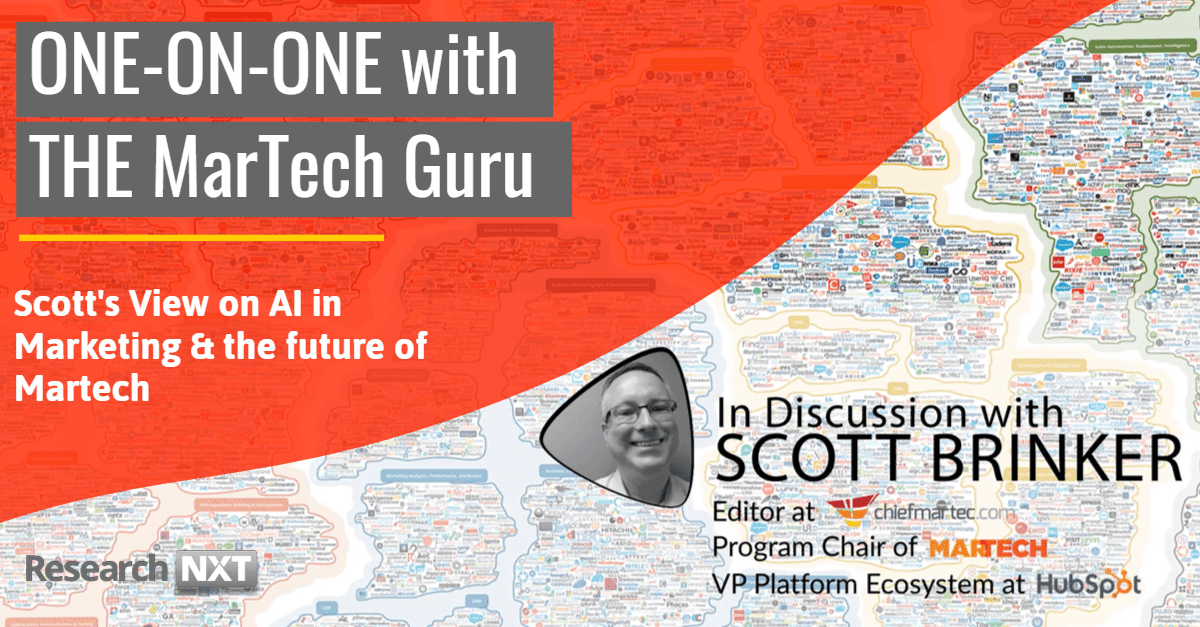
Scott Brinker is widely considered the chief evangelist of martech, who helped kick start the conversation around marketing technology. Scott created the Marketing Technology Landscape, charting the growth of the marketing technology industry from a few hundred vendors to over 8,000. In 2014, he launched the Martech conference, where he serves as the event's programme chair. He is the man behind the Chief Marketing Technologist blog at chiefmartec.com, which provides fascinating insights on the intersection of marketing, technology, and management.
He is the author of Hacking Marketing, published by Wiley in 2016, about adapting software management practices such as agile methodologies to marketing teams. He is a frequent keynote speaker at conferences around the world on topics of marketing technology and agile marketing, in his role as VP of Platform Ecosystem at HubSpot, where he helps the company create more synergy with the rest of the marketing technology landscape.
In this interview, we talk about his journey tracking martech's phenomenal growth and its evolution. Scott shares his views on AI in marketing, the Indian market, and the future of martech.
Marketing data really is the engine that is feeding a lot of AI possibilities in marketing.
You have been tracking the marketing technology sector for over a decade now. We would like to start by asking about this journey: why did you start building the landscape in the first place, what observations do you have in terms of its evolution, and what is the future?
When I first started charting this landscape, I believe it was 2010 or 2011. I was trying to persuade senior marketing leaders that they needed to incorporate more technical talent into their team, because this huge shift was underway, and marketing was becoming more and more driven by software.
This is a natural outcome of the world going digital: the places now where businesses and marketers need to attract, engage, and delight their customers are all the digital channels. So I put together that first chart in 2011, where I found something like 150 different marketing technology products that I knew of at the time.
It was basically to try to persuade those senior marketing leaders and say: take a look at how prolific marketing technology is. And the martech landscape chart had the exact effect I hoped it would. People looked at it and went, wow, marketing really is becoming a technology-powered discipline, look at all these technologies.
So I kept going back to that exercise every year thereafter, mostly for my own curiosity, to see how the industry was evolving. And to my surprise as much as anyone else's, it just continued to grow at an exponential rate. It went from 150 to 300 to 1,000 to two, four, and five thousand.
We just released the 2020 landscape last month, and it was 8,000 marketing technologies, and that is not even all of them out there. I look at the evolution from a supply-side and demand-side perspective. On the supply side, cloud software has changed everything. Cloud platforms such as Amazon, Google, and Microsoft Azure have just made it so inexpensive for people to learn. Quality software products on a global basis are available for really pennies compared to what it used to cost before. Then leveraging open-source software frameworks and being able to plug into global talent pools, there are almost no barriers to entry in software these days. And so you have this huge explosion of software entrepreneurship over the past decade.
On the demand side, though, marketers are insatiable. They are continually looking for ways to differentiate themselves from competitors. They are looking for ways to make their marketing operations more efficient and effective. They are constantly chasing where consumers and customers are going as far as new kinds of channels and touchpoints and expectations.
So it is almost like a perfect match for this incredible demand for better digital marketing capabilities and an unlimited entrepreneurial opportunity for new software to be created. You put those two things together, and what you see is this meteoric rise of marketing technology.
With the advent of AI, do you see a change in the market in terms of the kind of solutions coming up? Considering that now enterprise martech is available to all sizes of companies, are we also seeing a democratisation of AI technology?
Yes, I think in some ways AI is very similar to the rest of the dynamics of what is happening in the cloud, which is essentially incredibly cheap data storage and incredibly cheap computing power on demand. All these machine learning algorithms have been around for ages; the reason they were not very practical is because they just were not cost-effective, or we did not have the data at enough scale. Now, all that has changed in the cloud, and in fact all those cloud platforms we talked about, they all offer AI on-demand services, which make it really easy for any software developer to incorporate these algorithms into their products.
So I think yes, AI in many ways has become commoditised. It is available to anyone and everyone. Things get interesting when the algorithms themselves are very commoditised, because then where software products are going to be differentiated is what sort of data they can collect.
Because all of these different kinds of marketing touchpoints we see are collecting just very different types of data, so how do we stitch that data together and how do we relate that data is where things get interesting. This is one of the reasons you see so much innovation happening in the marketing data industry as a whole. Marketing data really is the engine that is feeding a lot of AI possibilities in marketing.
Then the second place where you see differentiation is the question of how do you apply it? Machine learning models are very good at taking a bunch of data and then spitting out some sort of prediction or extrapolation, some kind of recommendation, whether it is clustering or what have you. That seems pretty straightforward, but the question then becomes, what do you do with that?
How do you feed that back into the system to change the experience that a customer might be getting? How do you feed that into envisioning what the next best offer should be to someone? Figuring out where they are in their customer journey and what is the next best thing you could do to help move them forward. That is where all the really creative elements of AI come into the market.
What do you think is the future of personalisation? While marketers learn to use AI in more ways, how will that change as we start applying AI?
Personalisation is what I would say is a great example of applying AI to impact the customer experience dynamically. I think one of the challenges with personalisation is that it means very different things to different people.
Within e-commerce, personalisation has been incredibly effective for years now. These recommendation engines that upsell and cross-sell have proven to be very effective. We are still trying to get our arms around how to apply personalisation in content delivery effectively.
There has been this sort of grand vision that we have this universe of content, and we will be able to, based on some sort of machine learning algorithm, make a prediction about which subset of that content is going to be most relevant to a prospective customer at a given time.
I think we are still working on that as an industry, and partly because the way content was created in marketing historically was always very linear. People who were developing content were able to think of a continuous narrative, from the beginning to the end, that could hold together and be very compelling and persuasive.
But when you start turning over content delivery to these AI algorithms, the AI algorithm is combinatorically piecing things together into a narrative. While the individual pieces make sense, it is not always clear that the narrative arc across them holds together as effectively. So I think that is a little bit more of a complicated problem.
The silver lining to it is I think it is actually a great opportunity to continue to advance the state of the art when we are talking about personalisation.
During the Martech conference this year, you mentioned how it is no more the marketers chasing the vendors; it is more the vendors chasing marketers. Considering the shift to platforms, what trends have you noticed in terms of marketers building their martech stacks, and what are the opportunities for vendors now?
Certainly the size, as we talked about, of marketing technology has grown over the past several years. Most marketers still remain somewhat surprised by just how many different tools they can have in their stack. But I think the important thing to consider is scale, what you just touched on there by mentioning platform. Not all marketing technologies are created equal; there is very much a difference in scale with different marketing technologies.
You have these foundational systems that you know for content management, or CRM, or marketing automation, and customer data platforms. These at least have to be very large and widely deployed platforms. But then, on top of those platforms, you have an incredible number of specialised technologies.
For example, I use a particular tool for determining my optimum search engine optimisation strategy, a tool for social media, perhaps a different tool for influencer management programmes or community reviews, and so on. It is just an infinite number of specialised tools, so what you usually see in a martech stack is foundational systems used by the entire marketing department. And then within little groups within the marketing teams where those specialisations exist, they tend to get pulled together in their toolbox of tools that are particularly well suited for their tasks.
Much research was published around CMOs' decision-making as far as technology implementation is concerned. Has that shift really happened? Are the decisions for marketing technology more developer-led or marketer-led now?
Well, that depends. There is still a high variation from one company to another. If you have a CMO with a senior leader who is the head of marketing technology or marketing operations, they tend to have a direct relationship to the development of the marketing stack. When you have chief marketing officers at companies where there is less technical talent in the marketing team, they might rely more heavily on the IT department for those foundational systems.
To be honest, in a lot of companies now it is both. There is so much technology running the modern enterprise that it is not unusual for you to have an incredibly strong IT department that is helping to implement all sorts of companywide systems and providing really good governance and leadership for technology strategy overall.
At the same time, you can have a marketing department that has a great head of marketing ops and technology, and it is very much working in partnership with the IT department to deliver the marketing stack and manage the technology operations for the marketing teams in particular.
Do you think the COVID-19 pandemic has derailed that, or what do you see post-COVID in how marketers are going to bounce back?
It is hard to predict exactly what is going to happen because we do not yet know what the curve is going to look like. There are optimistic views of how this may work, and there are pessimistic views, and frankly at this time it is hard to predict. But I think if we step back from the immediate future, the short term future, and we say, let us look at what is likely to happen in the decade of the 2020s, I think it is inevitable that the world is going to continue to become more and more digital.
The role of marketing for attracting, engaging and delighting customers across all these digital channels is only going to grow. The sophistication of the technology that is available to us as marketers and as business leaders will only continue to advance. So I think over the decade, it is going to be an incredibly bright and productive future for marketing and marketing technology.
How big a dip we will see with COVID remains to be seen. A lot of companies are facing the economic pressure of this crisis. At the same time, a lot of them are recognising that adapting to this environment is one of the key opportunities of really leveraging a strong digital marketing infrastructure to adapt to situations like this.
So while there are certainly a lot of headwinds to marketing at the moment, in some ways this motivation to become more adaptive and more digital is a bit of a tailwind at the same time.
Scott, you have been in India recently, and you also interacted with some of the leaders in the Indian technology space. What is your observation for martech in India? Are Indian marketers innovating and putting the power of marketing technology and AI to use?
From what I have seen, I believe the answer is yes. In fact, India has always been such a strong entrepreneurial and technology culture. I actually think there is a lot of innovation happening in Indian marketing tactics that perhaps is not as well-known as companies here in the US.
You would know better than I would, but India has a very challenging market in some ways, given the way it is structured. And I think those challenges have really forced companies to be very innovative in how they grow.
I am extremely bullish on the advance of marketing technology in the market.