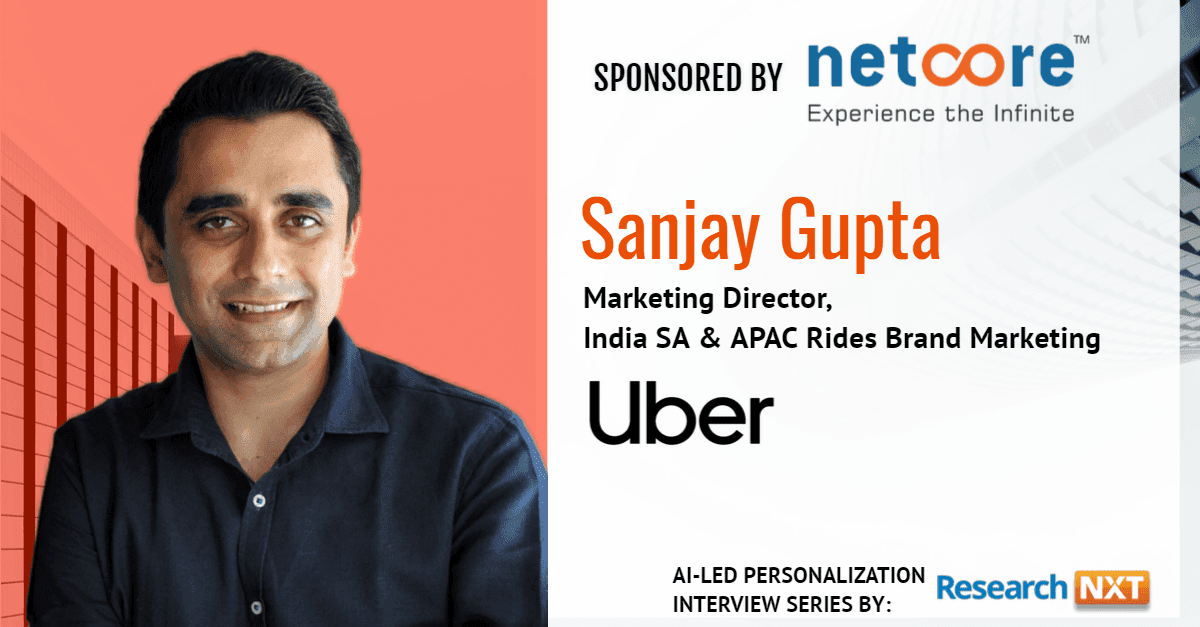
In this Research NXT interview, Sanjay Gupta, Marketing Director, India SA and APAC Rides Brand Marketing at Uber, talks about his journey as a marketing leader across consumer-facing brands, the intersection of the physical and the digital world, and how marketers should leverage AI to ensure its ability to self-correct predictions over time.
Key highlights
What this conversation covers
- How Uber is leveraging technology to personalise every rider's experience at such a large scale.
- How Uber has continuously updated its app to prioritise user safety, making it more accessible and easier to use.
- Sanjay's observations on the state of marketing in the current scenario, and how it would evolve in a post-COVID world.
Uber is a phygital business, as we play at the intersection of the physical and the digital world. And in this world, experience trumps advertising.
You have led marketing in the B2B and B2C segments in India and are now leading marketing for Uber in APAC. Let us start this discussion with your journey as a marketer and your observations on how the marketing technology landscape has changed.
First of all, thank you for having me on your AI-led personalisation series. About my career, if I were to use the Uber lingo, I would say I have had a 5-star trip. I have been incredibly lucky to be able to do what I love. Over the years, following my passion has led me to opportunities that have worked out well.
I started my career with Marico, a well run, innovative consumer goods company in India. Marico gave me a very strong foundation on both the functional aspect of marketing and the core principles of general management. I have had the privilege of working on strong brands like Parachute and Saffola as well. After that, I went into the ecommerce sector and moved to Urban Ladder, which revolutionised the way we bought furniture in a very customer-centric manner. It was my first startup experience, and the energy level and passion were infectious. It was also my first exposure to data-driven marketing, where we focused a lot more on insights and how information was synthesised. As you come into the data-driven world, you start looking at personalisation, personal storytelling, and how technology enables us to share it with the world.
So I think that was my first experience with data, and it was very enriching.
I then moved to Uber, which has been my most exciting and fulfilling role so far. Like most others at Uber, I am very passionate about our mission, and truly believe that we can reimagine how the world moves for the better. Every day, I get to work on complex problems with the brightest minds, which is very energising.
So, it is not only skills, but a majority of it has to do with just being there at the right place at the right time.
In your earlier interviews, you mentioned you want the ride in Uber to be an experience for every rider. With such a large global rider base, are you able to provide that experience consistently? How are you leveraging technology to personalise every rider's experience on Uber?
Uber is a phygital business, as we play at the intersection of the physical and the digital world. And in this world, experience trumps advertising. Your own personal experience on the platform has a far greater impact on your perception of the brand and your propensity to use it in the future. So right from the start, we have strived to deliver a magical experience for both our riders and drivers, as we see ourselves as an intersection of the two.
To bring the concept to life in terms of how it impacts and how technology plays a role, let me take safety as an example. Safety has been the number one priority for us right from the start. At the very core, we believe that technology should enable safer travel. To this effect, we have continuously updated our app to prioritise safety and make the safety features more accessible and easier to use. I would like to mention in particular four different features, two of which are more contextual to the COVID world, and two of which are our evergreen features.
Mask verification. We had our existing feature of drivers having to take a selfie and upload it in the system to ensure an information match before starting any trip. Now we have modified the feature to ask the drivers to take a selfie with a mask on before initiating any trips. Uber's new technology will verify if the driver is wearing a mask on all trips.
Go online checklists. Before a driver can go online, they will be asked to confirm, via a new go online checklist, that they have taken certain safety measures and are wearing a face mask. A similar checklist has been built for riders where, before every trip, they must confirm that they have taken precautions such as wearing a face mask and washing or sanitising their hands. By doing this over multiple trips, we try and keep the platform safe in the current COVID context.
GPS-tracked rides from start to finish. This feature, though not very technologically sophisticated, makes the rider feel safe. Through this feature, riders can see their route clearly marked, and view the real-time dynamic location of their car on the app throughout their journey. So they know exactly whether they are on course, making safety come alive on every trip.
Share your trip. This feature allows a user to share their trip with a loved one, and they will know where you are at all times in real time.
So, those are just some of the ways we leverage technology to ensure a better, safer, and in-the-moment customer experience for our riders in a very personalised manner, and this has been very critical at Uber.
I see that Uber is testing out the driverless car and many other things from an AI standpoint and an innovation standpoint. What is the progress on that front? I think our audience would be keen to know what is going on next at Uber.
Uber has been at the forefront in the use of AI with driverless cars. However, it is safe to say that both as individuals and as professionals, we are in uncharted waters now with the COVID crisis. What we knew about customers and some of the things that we took for granted have changed dramatically. And as custodians of the brand experience of the business, we need to adapt and relearn quickly. As a marketing community, for the next three or four months, we need to understand the new normal to win our customers' minds and hearts. I have three things that we should introduce. They are:
Start with the consumer, and seek to understand what is changing. What we knew about our consumers' behaviour, their lifestyle and their priorities has changed. The insights and knowledge we gained in the past will need to be re-examined. For us, as marketers, we need to identify our new early adopters and understand from them the new category codes, the new use cases, and new benefits, and reimagine our product portfolios to cater to the evolving new normal.
Win on the new category driver, hygiene safety. Our consumers have added a new attribute to all categories: hygiene safety. For any business with physical interaction with the consumer, hygiene has assumed a new meaning and moved up in the attribute hierarchy. What is interesting about this new paradigm is that in the absence of clear hygiene markers, consumers are evaluating hygiene based on their own safety standards. The lockdown has made us cognisant that our actions, both responsible and irresponsible, have a material impact on others. This has, in most cases, made us more responsible, and thankfully so. As brands, it is imperative for us to assume greater responsibility, to ensure that our standards are high, and that we deliver on them consistently. However, the key is to distil what is really important and not get lost in the myriad of signals that we are receiving.
Lead with actions and not ads. There will be a premium on acts, not ads. It is time for marketing to be more meaningful. They say leaders are judged in times of crisis, and our consumers will judge us based on what we did and not what we said. It is the time to be meaningful in your actions and thoughtful in your communication.
What is your observation of marketing in the current scenario, and how would it evolve in a post-COVID world?
I think there are a couple of things that will not change:
- Companies and brands that are customer-centric will still do well. And I think companies that promise what they deliver and deliver what they promise will do well.
- However, what will change is that we will have more opportunities for leveraging tech and insights to create meaningful personal experiences. We have changed markers in the category, or at the very least the priorities of what is important to our customers have changed. So if originally a and b were more important in a category, today there is an attribute c that is more important and allows players to win share or do better. Whoever is more customer-centric and can leverage data and insights in a better manner has the chance to win that particular category.
- Thirdly, we will need to be very thoughtful in how we communicate. It is not time to rush for business by leading with discounts and trying to drive usage. People are having a difficult time, and we, as brands, need to be very thoughtful and very empathetic towards what our customers need. Instead of getting the maximum out of customers as brands, we should try and give our customers the maximum. I think of this as a time to invest in that relationship and enable each other to just move forward from this crisis.