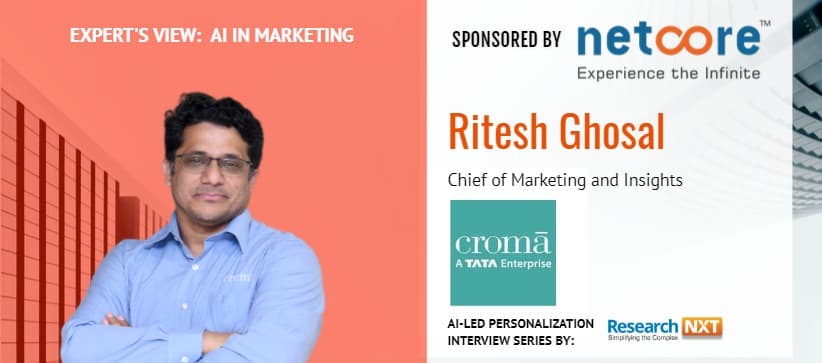
In this Research NXT interview, Ritesh Ghosal, the Chief of Marketing and Insights at Infiniti Retail Limited, Croma, a Tata enterprise, talks about his journey across top retail brands and his preferences for organisations that thrive on the premise of growth and innovation.
Key highlights
What this conversation covers
- How Croma follows the start small, scale fast strategy to empower internal teams and to optimise the inflow and stickiness of customers.
- The advantage modern marketers have with mobile technologies in fast-tracking campaign development and launch.
- The various customer-centric initiatives under development in the new tech-heavy stores of Croma.
Data is like the letters of the alphabet. The story has to be woven by the marketer.
Tell us about your role and journey through top retail brands until now. What inspired you to take up the position at Croma, Infiniti Retail Limited?
I have been a bit of a nomad throughout my working career. I have shopped for assignments that interest me rather than organisations that offer stability or a long career path. Starting my career as a media planner when India was opening its skies to satellite television, I have always looked for opportunities that put a premium on growth and innovation. In my experience, a team or an organisation chasing growth offers a more energetic and engaging work environment.
What attracted me to Croma back in 2015? Croma was a pioneer in modern retail whose fairy-tale start had lost its path in the face of aggressive discounting by online marketplaces. Croma was convinced that superior consumer insight and sharp, targeted marketing programmes would be their approach in the battle for the Indian consumer's heart and wallet. I was offered a large canvas and a relatively free hand in shaping the strategy of the company. As most organisations these days tend to restrict marketers to just delivering pretty picture communication campaigns, I found this assignment extremely attractive.
As the owner of the marketing organisation for Croma, how do you empower your team to optimise the inflow and stickiness of customers? Are you leveraging AI and ML to deliver marketing ROI, and how?
All decisions taken at Croma are based on insight, and all large-scale marketing programmes are based on the premise of start small, scale fast. What this means is that we need access to much data, and as near real-time as possible. Every vertical in the marketing team is engaged in understanding the impact of decisions taken last week, assessing pay-offs, and deciding whether to continue, refine, or desist.
We have invested in data collection tools right from social listening and internet crawling to doing conventional market research surveys. Each of these tools provides KPIs we track and lead metrics of those KPIs.
While it sounds very clinical and mathematical, it is not. I have never believed that data tells the full story. Data is like the letters of the alphabet; the story has to be woven by the marketer. I like my team to build the hypothesis of what might be happening or might happen in the future and use data to support this hypothesis. If the interpretation is convincing, then we design an experiment to test the theory. If validated, we expand the scope of the programme. Every change that has happened at the Croma stores and on the croma.com website has followed this strategy of start small, scale fast.
As you would have understood from the above, I am not much of an automation guy. We do use AI-driven algorithms in consumer targeting of communication in digital media, but it is minimal and one of the few areas where we do not yet have a firm assessment of the ROI.
Which aspects of marketing and technology integration interest you most? Something that excites you on a personal level, and why?
I think the entire digital revolution that our country has observed, starting with the advent of smartphones in the pre-2010 era, is a fascinating story, one which has many chapters still to be written. IT has transformed India once, and I think there is room for one more transformation. Reliable data at good speeds and reasonable prices, combined with low priced smartphones, are silently revolutionising the country. I started my working life when boot floppies and telexes were still in use. For me to be able to access everything I need from the office sitting in the comfort of my home is simply incredible. Indeed, I have lived through probably the most transformative 25 years, and with this COVID episode, I am probably looking at a period of even more rapid innovation.
In terms of marketing too, the smartphone has completely altered the scenario. Gone are the days when a marketer could spend months developing a campaign, launch it, wait for the media plan to deliver four opportunities to see, and then wait four weeks for Nielsen to report the market share outcome. Today, if a campaign is effective, it triggers an action right away on the smartphone. Indeed, smartphones are not just bought frequently, but they also influence everything else a person consumes.
With 170 Croma stores in 40 cities across India, how does Croma enable a personalised and unified experience for customers?
We have been rapidly scaling up, and we will have 170 open by the time the lockdown ends. The personalised experience is delivered via the store staff. We have an extensive training infrastructure that ensures each of our new hires is trained to follow the Croma sales process, which delivers our signature we help you buy experience. To ensure every store is complying with these SOPs, there is an elaborate system of internal audit checks and a third-party mystery shopper exercise. Besides this, every purchase is followed by an exit survey to determine whether the experience was satisfactory for the customer.
In one of your recent discussions with The Economic Times, you mentioned that Croma does not plan to pull back or pause the expansion plans due to the COVID-19 crisis. So would you please share the status of the Croma app and the new tech-heavy Croma stores as of now?
There are three separate and independent initiatives going into the new tech-heavy stores, as you call them. First, making our stores shoppable from the comfort of one's home. This requires us to be able to show store-level inventory, offers, deals and experiences to customers via our website or app. Second, enabling every store to access and sell chain-wide inventory from the store. And third, training our staff to be able to assist our shoppers digitally.
Each of the three initiatives is proceeding in parallel, with new deployments and capabilities going live every other week. For instance, as part of making our stores shoppable, we have just gone live with a request-a-call feature and a book-an-appointment feature. Most of the significant features will be live by the end of September this year, including the release of a Croma shopping app.