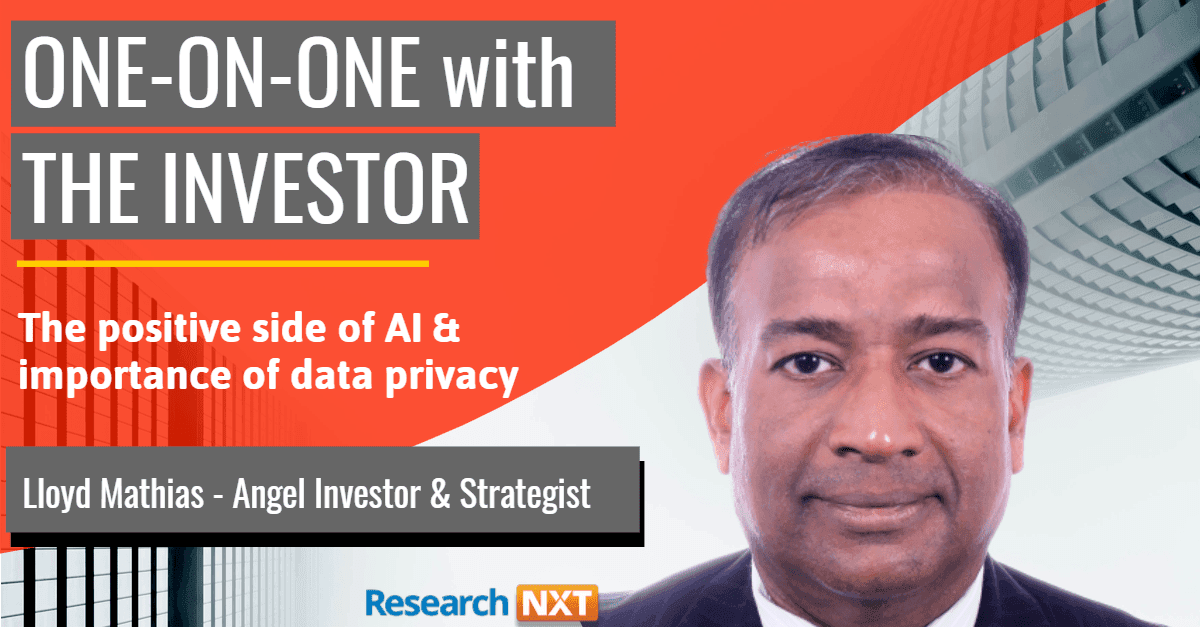
In this Research NXT interview, Lloyd Mathias, angel investor and business and marketing strategist, talks about his journey as a marketing leader across big-name brands, the significant change martech has brought to core marketing, and why marketers should safeguard and ethically use consumer data. Additionally, he discusses the advent and usage of AI in marketing and how marketers can now tweak every element of communication based on consumer preferences.
Key highlights
What this conversation covers
- Significant changes martech has brought about in core marketing practices.
- Importance of using consumer data ethically and effectively.
- The disruption that the COVID-19 crisis has brought upon the business ecosystem.
We, as marketers, need to recognise that there is a very fine line between targeting a consumer with personalised communication and bothering them to the point they drop out of the buying journey.
We would like to know your journey as a senior marketer across organisations, including HP, Tata Docomo and Motorola, some of the industry's leading brands. What has your journey been like as a marketer, and what are your observations concerning how the use of technology has evolved over the years in marketing?
In the past 25 years that I have spent on the corporate side of Pepsi, Motorola, and more recently HP, I think one has seen that the extent of technology usage has grown in leaps and bounds. To give you a sense, in the nineties when I just started my career, much marketing was about turning out a 30 second TV commercial and then, of course, putting media behind it to create large-format ads and billboards. Technology's role then was very limited. However, now everything has moved to the digital medium, from short commercials to artworks. But more importantly, I think it is the pace that has changed.
To share a perspective, back in my Pepsi days in the late nineties, we spent at most on three big campaigns yearly, which included a big summer campaign starting March, then the back to school campaign in June, July and August, and another one was the festival or Diwali campaign. Fast forward to my last stint at HP recently, where we ended up doing 40 to 60 campaigns in a typical year. This is because the consumer attention span has shrunk; campaigns have become smaller, targeted, and less expensive. Today a video commercial can be accomplished digitally for about 10 to 15 lakh rupees, compared to the big-budget and format campaigns with Bollywood celebrities that were priced at whopping crore price-tags.
To sum it up, the following are my observations:
- Firstly, the usage of technology in marketing has increased at a faster pace.
- Secondly, marketers can segregate and segment their audiences in a tighter way, enabling them to have a much better sense of their budget utilisation.
- Third, thanks to the wider spread of digital, marketers can now zero in on audience communication almost to a one-on-one level, and therefore the tweaking of marketing communications is more focused. It is no more a spray and pray approach.
So, I have seen a great improvement in technology, largely for the better, because now you have a much better sense of your budget utilisation, you can pretty much track how hard your marketing is working in terms of how many customers are being reached, and when it comes to digital you are able to pinpoint the positive action, whether it is the click, or the engagement, or the time spent, or whether it is a customer who has actually bought from you. You get the entire value chain. So, I think there has been a significant and positive increase, and martech has started dramatically impacting core marketing.
Now you are an investor, and you have many startups under your portfolio, where you are working very closely with them on their marketing strategy. What is your observation concerning the startup ecosystem building in India, and what kind of new age marketing is used amongst these young organisations? Do you see a difference considering the conventional way we used to do it, and how startups are now able to have the same level playing field?
Great question. I would say two things. Firstly, for startups, given the ticket size, and a lot of them being early-stage companies, I think digital is a lifeline, unlike large companies with deep pockets who can invest in mass media and print. For many startups, digital is the primary marketing medium to reach out to consumers, which makes digital very critical. And that is where they spend a lot of their marketing budgets.
Secondly, there has been a dramatic evolution in inbound marketing. Until about a decade back, no one had heard of it. It is really about how you attract consumers to visit your site, how you might put a lot of interesting articles and links out there. And the moment you see a consumer having some interest, you are able to zero back in on them with more in-depth product information. So, marketers can guide the consumer through the entire purchase cycle. And today, there are inbound marketing tools like HubSpot or Eloqua available to do it, through which you can guide the consumer through the entire purchase funnel, starting with their interest, then getting them to interact a little bit more, and then possibly make a direct sales pitch.
With these aspects, digital has ensured a more democratic level playing field where even a startup can compete with the big corporations, because the size of the budget does not matter so much now when it comes to buying a Google search or targeting a consumer on a social media site. The cost of making a lot of creatives, whether it is a digital one, a meme, or a Facebook or Twitter post, is not too much. So in that sense, it has made the whole marketing world flat and easier to access.
This is a very positive aspect for the startup ecosystem, primarily because consumer attention spans are shrinking, and very often they say a good brand is based around emotion and telling a story. So I think many marketers today cannot get that consumer time and attention and thus cannot build a long story. So to look back at the last two decades, some of the lines that have stayed the longest, like Yehi hai right choice, baby, or the choice of a new generation by Pepsi, that were used for years and even longer, are no more the case now. The typical campaign duration has reduced from high budget and longer time frames to just a few months.
You have touched upon a critical point on the consumer's attention span. What recommendations would you suggest for brands who are planning or using AI and personalisation to throw the right content at the right time? Moreover, how can they personalise their communication with each of their consumers?
For any business leader, understanding and identifying the right consumer and the relevance of their product is very important. The moment I know my target audience and I know the relevance of my product, I can target them accurately. However, if I get my audience targeting wrong, and then I use sharp digital tools to direct communication at them, I will irritate the audience who are not my consumers. Or if I have got my consumer segmentation right but my communication is not relevant to the consumer, then I am again going to get a very irritated audience because I am targeting someone for whom it is not relevant. So, I think there are two elements: one is relevance, and the other is the ability to target.
What has happened nowadays is that thanks to AI, marketers can tweak every element of their communication. Which means, if I am out to sell you an automobile and I know that the prospect is an outdoorsy person who follows the English Premier League, we can determine their reading or viewing habits. And with the use of programmatic to buy relevant channels, a marketer can serve the relevant automobile advertisement, depending on their lifestyle and other parameters. This capability ensures that marketers do not make the mistake of serving a consumer looking for a luxury car with some low-end car instead. You are avoiding the wrong communication.
As marketers we need to recognise that there is a very fine line between targeting a consumer with personalised communication and bothering them to the point they drop out of the buying journey. One of the reasons this way of targeting is possible is a shift in media buying, which has moved to programmatic buying. There was a time as a marketer, if you were looking for a male audience in the 31 to 45 age group with a higher income, with a very clear definition of the persona, you zeroed in on a city, on a particular medium like The Economic Times or one of the airport lounges. With programmatic buying, what is happening is that once you have a consumer profile, you can target and serve ads depending on the best cost. For example, if display ads in an airport lounge are costly, you can alternatively target that same consumer on a stock market website like moneycontrol.com, with a fraction of the budget you would have spent on the airport lounge display. But like I said, relevance is the essence, and I think that is the part that marketers need to spend a lot of time and attention on.
In one of your articles for the Times of India, you mentioned AI, ethical issues, and data usage. Are there new standards that have been followed, and is AI safe enough for marketers to communicate with their target audiences to be more relevant?
I think the data safety aspect was never doubted, and marketers need not worry about that. It is also positive that we, as marketers, are moving towards an interlinked AI world, and this disruption is only accelerating the process. Likewise, every big disruption starts with reluctant change, which ultimately becomes a norm. For example, an extended family Zoom or a Google Hangouts call is now a norm; digital payments after demonetisation in India are also a norm these days. So, the point that I was suggesting in the article is that AI is inevitable and good. Consumers welcome relevant communication and do not see it as an infringement.
Having said that, there have to be certain norms since this space is evolving very fast. These standards should safeguard a consumer against spamming with irrelevant communication and ensure that consumer privacy is not compromised.
Another example is of the younger generation, who are far less conscious of privacy. They often put out things in the public domain through social media which are personal. However, as you grow, you recognise that your digital footprint remains and may come back to haunt you. Some of what you have committed to the net could impede your next job interview. So as long as data is collected anonymously and used to target consumers in a general sense, all is well. However, when you link that data back to a person, and if their privacy is being compromised, it is a serious problem.
So my point is that AI is positive, and there is no stopping it. It is the future. It is the direction we are all headed towards, but good norms and standards need to be built and agreed upon. And the same yardstick has to be used all across.
Another big advantage of AI is in medicine: for instance, remote diagnostics is now a reality. Even more important is the realisation that a machine can interpret results, whether a CT scan, an X-ray, or a blood report, by learning from millions of other reports in a manner that is far more accurate than an expert physician. So, the world's best heart specialists in their own life might have watched 60,000 ECG reports, but the machine could learn from 600 million reports. Of course, there is always the human judgment element that cannot be ignored. But the fact is that in areas like this, the role of machine learning can improve outcomes tremendously. The benefit of this is going to be significant.
Our next question is around the current disruption that COVID-19 has caused to practically all businesses, some on the negative side and some positive. As an investor and a marketer, how do you see this changing the landscape for marketing in the upcoming business world post the COVID-19 era?
Every change presents an opportunity for improvement. In this context, there are two or three broad opportunities in this crisis. They are:
- Accepting that technology is now an integral part of our lives. And keeping aside the importance of social connections, we have all started to relook at the need to have large physical office spaces. This will also be driven by the associated need to reduce traffic and fight pollution.
- The second big disruption is that of the remote working culture, which will be a big fillip to the gig economy. We now realise that many of our teams can work remotely and yet be very effective. This realisation will safeguard those in the workforce who earlier had to take a gap from office due to their inability to attend regularly in person. This kind of shift is also possible because there has been a great improvement in data bandwidth and speeds, and video conferencing has become a way of life.
- The third and most important thing is more in the context of organisations and startups. The pandemic has reinforced the value of resilience. All of us had business continuity and contingency plans. However, none of us were prepared for what came upon us. So I think the biggest realisation we have is the need for resilience to withstand any big disruption across our personal, professional, and social lives.