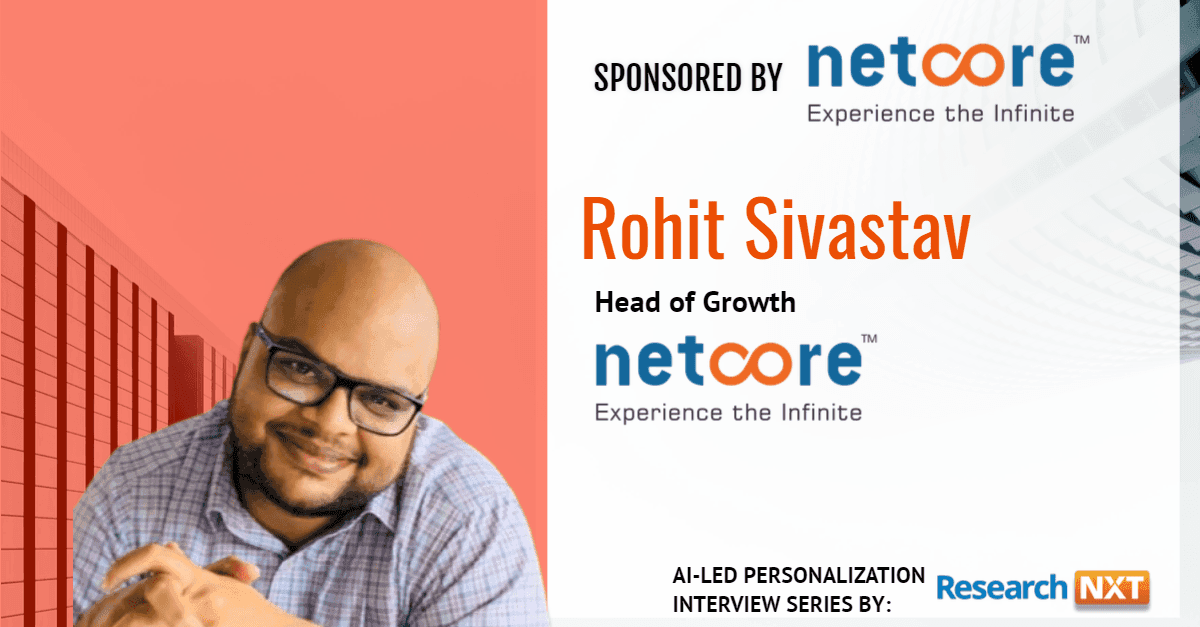
In this Research NXT interview, Kalpit Jain, the Group CEO of Netcore, talks about how the marketing world has evolved to embrace contextual engagement and personalisation significantly. He also mentions how this pandemic made businesses focus on investing in marketing technology tools to create better customer journey programmes to retain their consumers.
Key highlights
What this conversation covers
- How businesses can acquire revenues from their existing set of clients with better communication and engagement.
- Why Netcore has made significant investments in the AI space and in AI-enabling its offerings.
- How Netcore helps its customers build a truly unified view of their consumers and leverage it through the platform.
Personalisation is becoming a clear need for consumers, which eventually becomes the need for the brand.
I recall that in 2017 we interviewed you, discussing the evolution of marketing automation in India. We are a long way from there, and in 2020 marketing automation is the norm in every organisation, and Netcore has been at the forefront of this journey. So, as someone working with some of India's largest organisations, what are the shifts you have observed? What kind of transformation journey have you seen within your customers?
I think since 2017, a lot has changed. Companies earlier were not as focused on customer engagement at an individual level or even at a segment level, even though they were sending out communications to the consumers. Then with COVID-19, companies have started realising that there is a lot more they can acquire in terms of revenues from their existing set of clients with better communication and engagement. This pandemic also made businesses slash their advertising budgets and focus on investing in marketing technology tools to create better customer journey programmes to retain their consumers. Apart from that, I think businesses now do not look at individual digital channels or silos any more. Way back in 2017, businesses might have been looking at different vendors for their marketing requirements. However, businesses now have no issues with a single solution provider that can help them create the customer journey and engagement programmes across multiple digital touchpoints and build a unified view of their consumers. With this, data is also getting a lot more important for brands, as it helps them power a lot of these engagement programmes and connect with every digital interaction of their consumers. Not just the digital interaction: brands have also started taking count of offline interactions of their consumers and started putting those into their customer data platforms to create a unified view of the consumers and create multiple segments and customer journeys, so that the communication is very contextual and relevant.
That is all I think I have seen change over time. When it comes to contextual engagement, personalisation becomes very logical, as consumers of these days want brands to engage with them personally. Personalisation is becoming a clear need for consumers, which eventually becomes the need for the brand. We have seen how the Amazons and Netflixes of the world operate with personalisation, which is best in class. Brands now have started seeing the role and importance of personalisation and how it helps them create better consumer engagement.
Looking at the broad industries that participated with us in this particular initiative, like BFSI, OTT, and D2C ecommerce, we have seen certain specific trends. Traditional organisations getting to digital, and digital-first organisations implementing the best practices you mentioned about Netflix. Are there any trends that you have observed while working very closely with these organisations on the personalisation front?
Digital-first businesses would adopt some of these things quickly, because all of their consumer data is already available in a digital format. They have the consumers' digital identity, which could be the mobile number or the email address or the app token. It was very apparent for them to adopt these technologies early in their business and customer life cycle processes. But we are also seeing that many traditional businesses are moving very fast after this pandemic situation hit us. Most companies realise that digital is the way ahead, and all the traditional companies are now moving many of their businesses on to the digital side. I think they are also equally catching up fast, as we have seen many offline retailers coming up with their online digital properties. We want to see how we can leverage whatever data they have from the offline part and use it online. Though they might not have all the consumers' digital handles, they are still trying to move in the right direction. For example, the retail business collects the consumers' mobile numbers to engage and interact with the buyers on the digital channels. They might have taken time to adopt digital technologies, but this pandemic has fast-tracked the initiatives.
Maybe in hindsight, the pandemic has expedited the process of companies getting digital. Now, Netcore has made significant investments in the AI space and in AI-enabling your offerings. So how are you positioning yourself in the industry? What is Netcore's current positioning, and what is the way forward? How do you see Netcore a couple of years down the line? What are the segments you are playing in, and what kind of new offerings do you have for your customers?
At Netcore, we always believe in offering a full stack to our customers. We have always been very good when it comes to the delivery of the communication. Be it how well we can deliver an email, an SMS, or an app notification. Hence, the message's delivery becomes the most important layer, and we have always been very good at it for many years. At the same time, we believe in offering the full stack, as it is not just the delivery of the communication. It is about who should be communicated to, what content should be used to communicate, what time is right for the communication, and what channels would work best, using the whole automation layer, the segmentation, the customer journey, and all the other layers. On top of that, when we look at many machine learning models, the marketer is assisted by the machine to make decisions based on segmentation and behaviour. For example, the machine suggests the marketer target a particular audience group on the weekends and another group more through app notifications instead of emails.
It is about how the intelligence layer is put through machine learning into the AI model. That is why we at Netcore are investing a lot in the ML and data science initiatives. We also realised that many brands in countries not just like India and Southeast Asia, but also in the US and Europe, consider services as very critical. Since marketing tech platforms are quite complex with many features and capabilities, services in developed markets have become very important. So we are offering a solid layer of customer success management team on top of the entire stack, for handholding the customers, resulting in better product adoption and feature usage.
Further, we identified that while all of these were important, the most critical layer beneath all the layers is the CDP, the customer data platform, layer. Customers now want to invest in data from different sources.
Earlier companies used to keep and use only the marketing data. But now marketers realise that consumer data is not restricted to marketing data; there is a lot of transactional data, social data, and a lot of offline data, which are equally important. So they are looking at integrating all these data across all of the other properties into a CDP. The trend currently is that our customers want to build a truly unified view of their consumers and want a platform that can help them do that. Another interesting trend we are also seeing is that companies also realise that not every customer is the same. For example, out of the million subscribers they might have, there are segments of most loyal customers who give them the maximum business. And hence, marketers now want the marketing tech platforms to identify these critical consumer segments and suggest the best engagement tactics based on their behavioural data across touchpoints. Again, it is in line with the 80-20 rule, where 20% of your best customers give you 80% of the business. We also studied with our data and found out that 20% of our top customers give us 200% profit for enterprises.
So it is about how we help enterprises identify the new best customers through the unified view of the data, and then create marketing programmes and customer engagement programmes for those customers, to treat and engage them exclusively to give the larger share of profits. Hence, we also came up with this concept of velvet rope marketing, where we treat your best customers somewhat differently from the rest. We even use these best customers' digital footprint and leverage it to get the next best customer through best customer data intelligence, run advertising campaigns to showcase success stories, and so on. I think this is also becoming an increasingly important aspect, because marketers do not want to spend money on acquiring customers who will not be their best customers.
Hence, I think this whole marriage of marketing tech and advertising tech is now coming up and becoming a reality. Marketers willing to spend money on acquiring new customers wish to spend it optimally to get to the best customers.
When we last interacted way back in 2017, we spoke about the shift of technology-related marketing budgets from a CIO organisation to a CMO organisation; India, of course, lagged on that shift compared to other regions. So, what have you observed, considering 2017 to 2020 now? Have those budgets shifted from the CIO organisations to the CMO organisation, and is the CMO organisation now a well-integrated technology plus marketing organisation?
I think the shift has happened in the CMO organisation as well as in the CIO organisation. At least many traditional companies have started collaborating a lot to ensure that they can implement the right marketing technology tools, which will help the organisation become better in their customer engagement and retention programmes.
While we have seen more collaboration, maybe budgets might not have moved. Because the two teams and the two functional units are collaborating, their budgets are available, and they know where they need to be investing the funds. In many digital-first or app-first companies, I think an interesting function that probably three years back might not have existed as much is called a growth function. These growth and retention heads are becoming a very critical role, because in many cases they report to the founder or the COO instead of the CMO. So this can be an exciting change we have seen in the app-first and digital-first organisations, where product and growth teams work very closely to make decisions on platforms like ours. They are calling the shots, and in many cases this is a new avatar of growth marketer who is making the decisions on marketing technology selection. This role evaluates how a new martech integrates into their app or website, and how good the platform would be at letting them know, engage, retain, and make more revenue from existing customers. We have also seen some of this happening in traditional companies; however, I think it will take some time to become a formal role. This is an obvious investment, since companies are now starting to allocate funds towards marketing tech or customer retention and engagement platforms.
The last thing I would like to touch upon: when we spoke earlier, you had a very different schedule. You have your Thane office and Lower Parel office, and you had many meetings across these offices. However, things would have changed; the whole landscape would have changed for everyone. How is Netcore operating now when it comes to operational management? How are you adapting to this whole new normal?
Honestly, when it all started, we were not very confident about how an organisation of our size, with almost 600 plus people, can operate remotely. We had our own set of apprehensions when we got into the lockdown. But I think we have come a long way, and the teams have really evolved and transformed very quickly to manage things remotely. There has been a blessing in some form, given that now we can do more customer meetings across geographies sitting where we are. I can speak to all of my customers in Indonesia, Africa, and the US sitting out of India, whereas earlier I had to fly down to customer locations. I think we were all operating remotely, and that is just the reality today. Still, I think we have become a lot more efficient in doing customer interactions using technology tools and engaging with our customers. And at the same time, given that we were in Mumbai, travel used to take much time for many people. Now we are saving at least two to three hours a day on travel, and the stress related to it has completely gone away.
We do try to have some work-life balance through a lot of employee engagement sessions and programmes. We conduct a fun exercise break week, where we refrain from any official communication for a short period, and many interesting things are happening. I think organisations like ours would benefit from working from home, though on the whole in-person meetings allowed us to get to know each other, and the customers, better.