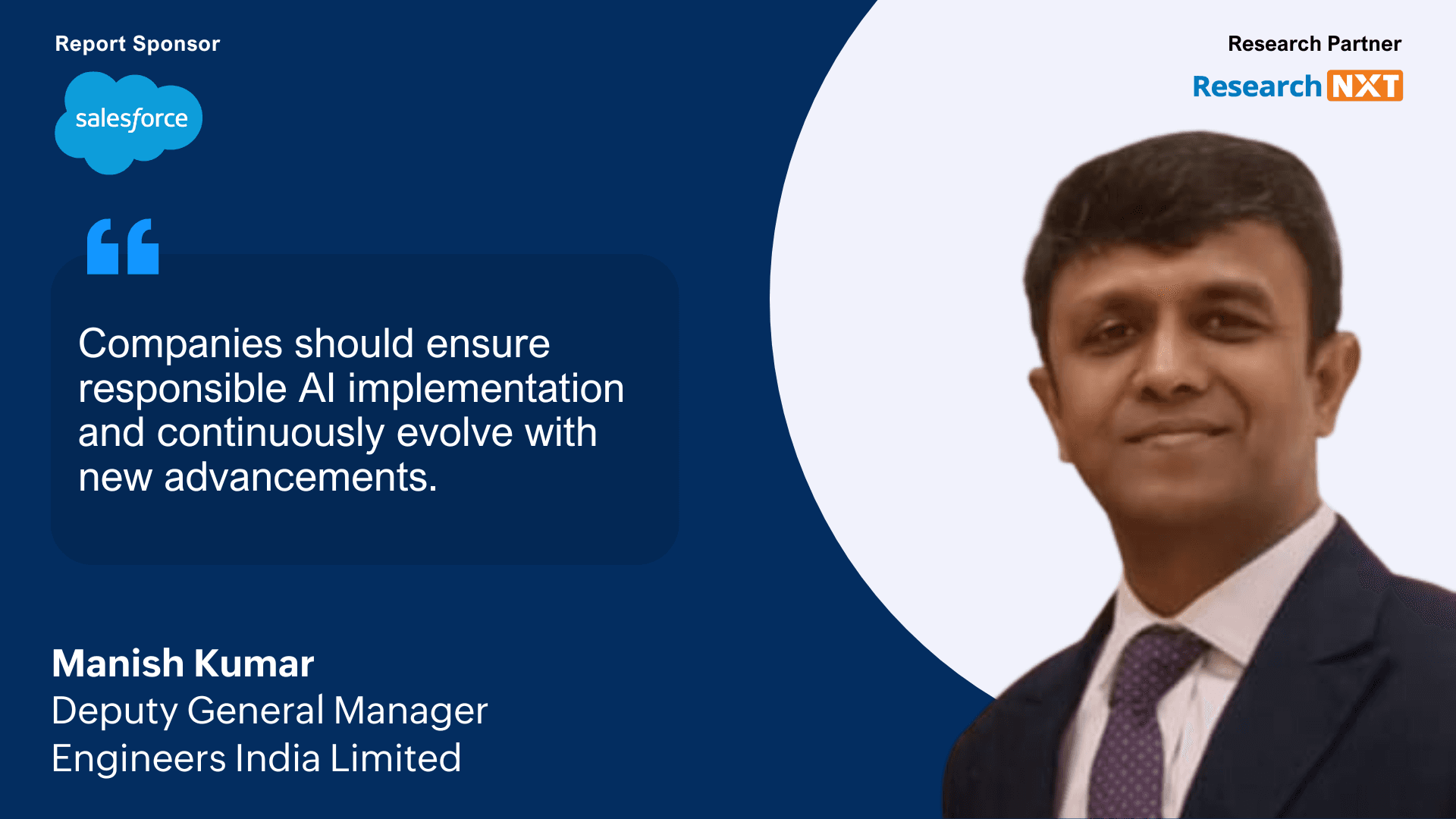
Manish Kumar, a seasoned engineering and infrastructure expert, discusses the evolving role of AI in large-scale projects, predictive maintenance, and process optimisation. He highlights the challenges of AI adoption, including legacy system integration, evolving AI tools, and infrastructure investment, while also outlining key trends shaping the future of engineering and industrial automation.
Key highlights
What this conversation covers
- AI-Driven Engineering InnovationsAI is enhancing predictive maintenance, engineering design simulations, and real-time project monitoring, improving efficiency and risk management.
- Challenges in AI AdoptionInfrastructure investment, employee upskilling, and rapid AI advancements pose hurdles for organisations scaling AI adoption.
- Modernising Legacy SystemsCompanies must integrate vast engineering databases into AI tools to achieve seamless automation and decision-making.
- Real-Time AI & SafetyAI-driven sensor analytics and real-time data processing are improving safety and efficiency in industrial operations.
- Measuring AI's ImpactAI adoption is reducing manpower costs, streamlining project management, and enhancing digital documentation workflows.
- Responsible AI in Large-Scale ProjectsDespite AI automation, human oversight in engineering design and project monitoring remains critical for compliance and accuracy.
- Emerging AI TrendsAI-powered 4D modelling, digital twins, predictive analytics, and automated risk assessments are set to transform industrial automation and infrastructure planning.
- Strategic AI AdoptionOrganisations must carefully evaluate AI tools, focus on customisation, and ensure integration with existing engineering and project databases.
AI is transforming engineering and infrastructure, but for true impact, companies must integrate vast engineering databases, ensure responsible implementation, and continuously evolve with AI advancements.
With your extensive experience in engineering and infrastructure, how has your role evolved with the growing adoption of technology and AI in the sector?
Now, our traditional engineering roles have changed as we moved from manual drawing and data transfer to computerised drawing design development. Also, the flow of engineering data from one engineering discipline to another has become seamless for further engineering, reducing the error. And engineers have to keep updated with new engineering tools alongside core engineering principles.
How do you see the integration of AI impacting large-scale engineering projects and infrastructure planning?
The AI-based tools used in engineering projects are a great move in reducing engineering error and speeding up engineering, that is, reducing the project life cycle time, improving the quality of works as well as real-time project monitoring.
How is AI currently being leveraged in engineering design, predictive maintenance, and project management?
AI started entering predictive maintenance long back and now it is going in a big way, making engineering design, maintenance and project management much more easily understandable.
What are the most promising AI applications that you believe could enhance efficiency, risk management, and process automation in the industry?
AI-based simulation for process optimisation, safety risk analysis in process operation and, of course, predictive maintenance analysis, 4D modelling engineering design, real-time material movement and expediting of material supply, construction progress monitoring, and AI-based suggestions will help in design engineering, construction, commissioning and operation of the plant.
Many organisations in engineering and industrial sectors are at different stages of AI adoption. What do you think are the key factors for scaling AI implementation successfully?
The infrastructure development investment required for adopting AI in various companies is one of the key factors, as is adoption by employees of AI-based engineering, design and project management with the available skillset.
One more important factor is the fast changes and development in AI technologies, which is making organisations reconsider their choice of AI tools and the ROI. By the time an organisation is trying to gain over the investment in AI tools, a new development happens, which again asks for new investment.
What challenges do organisations face when modernising legacy systems and integrating AI-driven automation into their operations?
Immediate investment for infrastructure for AI-based engineering project management. And the fast changes in AI-based technologies available in the market for engineering design and project management.
How do data analytics and AI models support better decision-making in engineering and project execution?
It helps to some extent. However, this still needs lots of databases to be integrated with various types of projects. Again, each project has unique features and this needs lots of integration with existing databases. Each client has their own choice of engineering design basics which still needs to be built into AI-based tools. Lots of work still needs to go into this: engineering, design, project management, construction and commissioning management, and finally operation management.
What role do real-time data processing and sensor-driven AI analytics play in improving safety, efficiency, and predictive modelling in large-scale projects?
It has started playing a great role, and the industry has started using it for predictive maintenance and operation safety. This is really improving the safety and efficiency of the industry.
How do organisations measure the business impact and ROI of AI-driven innovations in engineering, project management, and industrial automation?
As AI tools are being used in engineering, project management and industrial automation, they have started showing impact in saving manpower, cost saving, ease in engineering project management, cost saving in documentation due to digital documentation management systems, and seamless flow of data.
What KPIs or success metrics should industry leaders focus on when evaluating the effectiveness of AI-driven engineering solutions?
Efficiency and quality of works are what leaders should focus on while evaluating the effectiveness of AI-driven engineering solutions.
Given the high-risk nature of large-scale engineering projects, how should organisations ensure responsible AI implementation, minimising bias, errors, and compliance risks?
Even though AI-based tools are used, for large-scale projects proper checking and monitoring of the engineering design and project progress still have to be done by the engineering team and project team, to ensure correct engineering and project progress in line with the agreed project schedule.
What emerging AI trends do you believe will have the most transformative impact on engineering, industrial automation, and infrastructure planning in the next 3-5 years?
AI trends are definitely going to transform engineering, industrial automation and infrastructure planning in the near future. However, lots of engineering databases and project databases still need to be built with AI tools for the correct and proper functioning of AI tools for engineering and project management.
Lastly, as this conversation contributes to a report on AI adoption, what insights or recommendations would you like to see highlighted to guide businesses and leaders in leveraging AI effectively?
It is recommended to check the effectiveness of the available AI tools which are being selected for engineering and project management. Lots of customisation is still required for the proper functioning of the AI tools for engineering design and project progress monitoring. And lots of development and database integration are still required for properly developed AI-based tools for engineering and project management.