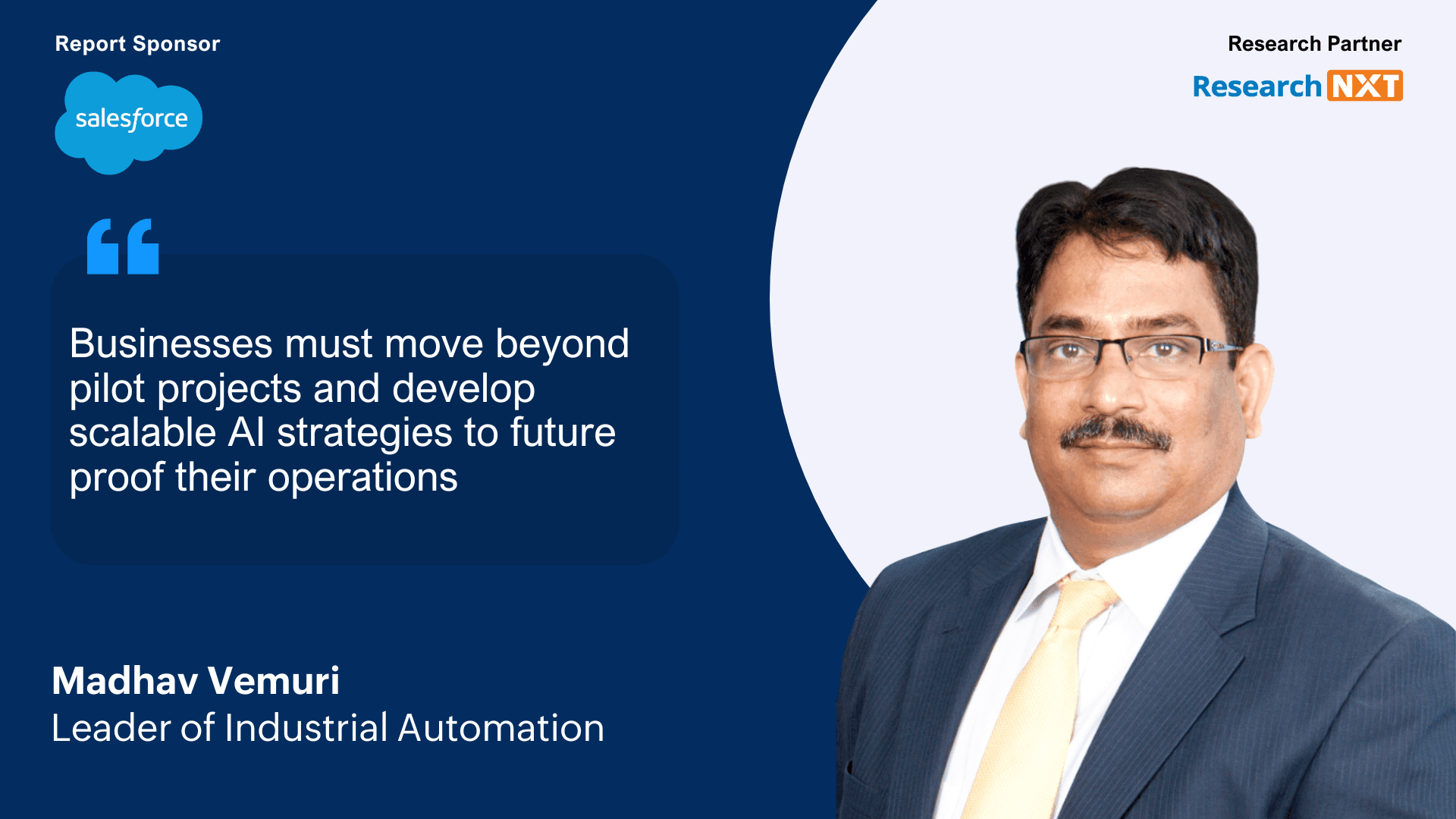
Madhav Vemuri, an accomplished leader in industrial automation, manufacturing, and digital transformation, shares his expert perspective on how AI reshapes the manufacturing sector. With extensive experience at ABB and leading various industrial and startup ventures, Madhav has witnessed technology evolution from basic automation to AI-powered intelligence.
Through this discussion, he delves into AI-driven predictive maintenance, operational efficiency, supply chain optimisation, and the strategic roadmap businesses need to adopt AI effectively. He also explores AI's ethical implications, governance challenges, and the future of Industry 4.0.
Key highlights
What this conversation covers
- From Automation to AIManufacturing has evolved from operator-centric operations to AI-powered intelligence, fundamentally altering how industries perform.
- AI's Impact on Predictive MaintenanceAI enables real-time monitoring of production critical assets, predicting failures well before they occur and so optimising the Total Cost of Ownership through pragmatic maintenance strategies.
- Supply Chain TransformationAI is moving supply chain planning and management from reactive to data-driven models and simulation tools, improving efficiency, reducing waste, and enhancing just-in-time approaches.
- AI Adoption BarriersLegacy infrastructure, fragmented data systems, and workforce upskilling remain key challenges to scaling AI initiatives and the gains they bring.
- Ethical AI & ComplianceAI adoption must be accompanied by responsible governance, unbiased models, and compliance with industry regulations.
- The Future of ManufacturingAI-powered digital twins, autonomous decision-making, and hyper-personalisation will define the next phase of industrial evolution.
The cost of inaction is far more detrimental than the cost of AI adoption. AI is no longer optional, it is a competitive necessity. Businesses must move beyond pilot projects and develop scalable AI strategies to future-proof their operations.
Could you start with a brief about yourself, your journey, what you worked on, and what you are currently working on so that anybody reading this would understand the context?
I started my career as an instrumentation engineer in 1987 with Instrumentation Limited, a public sector unit in Rajasthan. That was my formative time when I gained knowledge of correct engineering practices and designing complex process applications.
In 1993, I joined ABB to take up steel sector-specific solutions. My strength has always been across core process industries. I worked on a few mega projects like Rourkela and Bokaro steel plants, dealing with continuous casters and Steel Melting Shop (SMS) projects. This experience exposed me to holistic industrial offerings beyond instrumentation and automation, encompassing power systems, plant electrification, process optimisation, and integration with mechanical and process subsystems.
Between 1993 and 1999, I gained a 360-degree view of project businesses, including technical aspects, project management, customer engagement, and arbitration-related issues. Later, I held various leadership roles, including setting up ABB's first global execution centre, scaling it to 7,000-8,000 people and incubating across multiple global locations including the Czech Republic, Mexico, Egypt, and China.
After moving to Indian operations in 2012, I led the service function and the industrial automation division for ABB India, where I worked on digital transformation and operational excellence initiatives with major clients like Reliance, Tata Steel and Mines, Aditya Birla Group, ITC Paper, DCM, among a few others.
After a 34 year corporate stint, I decided to leverage my experience in a different way, so I started my own venture and began coaching and transforming startups. My focus has been on helping startups that need a 360-degree perspective, pragmatic business planning, solution enrichment and positioning strategies. Now, I continue this work across various industries, including life sciences, ed-tech, healthcare, and retail, beyond the core process and discrete industry sectors.
Given your vast experience, how have you seen technology transform businesses over the years?
When I started my career in 1987, we had a drafting solution called the DP Drafting Package. AutoCAD and other modern design tools did not exist at that time. We had only one electronic typewriter in the department and a few computer systems used only for DCS programming.
Fast forward to today, technological advancements are unbelievable. Digital tools have unlocked tremendous value, improving productivity and innovation. Sales processes, for example, have moved from reactive, inquiry-driven approaches to proactive customer engagement methods supported by CRM tools like Salesforce and Zoho. Today, businesses track entire customer journeys, convert early opportunities into leads, and create predictive models for engagement. New techniques like sentiment and pattern analysis open up totally new paradigms in unleashing the full potential.
In manufacturing, the maintenance approach has been significantly transformed due to the infusion of advanced technologies and AI/ML techniques. Previously, maintenance was dominantly time based or reactive: equipment failures led to repairs. Now, AI-driven condition based maintenance, supported by early fault detection and leading indicators, ensures that failures are prevented, reducing unwanted downtime and improving overall operational availability, reliability, and efficiency. AI is helping immensely in optimising production operations, energy consumption, and raw material usage, making industrial processes more efficient and cost-effective.
What are the key AI use cases impacting manufacturing today?
AI is impacting every aspect of the value chain. In supply chain management, for example, AI is eliminating manual inefficiencies. Earlier, material sourcing was based on fear of availability or delayed deliveries, leading to excessive stockpiling. Now, AI-powered procurement analytics provide actionable insights on material availability and when and where to buy from, ensuring optimal costs, uninterrupted production, and reduced waste across the entire value chain.
On the production front, AI helps to optimise the overall business outcomes through a meaningful integration of IT and OT systems, monitoring raw material quality, tracking machine conditions, and connecting the business systems to maximise the enterprise value and customer experience. Industries like food and beverage and automotive manufacturing have successfully leveraged AI to streamline logistics and optimise production scheduling.
As said earlier, AI-powered predictive maintenance is another game-changer, enabling manufacturers to detect potential failures in advance and take preventive action, thus reducing downtime and improving throughput.
Many manufacturing firms are at different stages of AI maturity. What are the critical steps businesses should take when evaluating AI for their operations?
AI implementation must be approached strategically. Many industries struggle because they adopt AI in silos without assessing the sustainability of the impact, rather than integrating it into a comprehensive digital blueprint at the plant or enterprise level.
The first step is defining a digital transformation roadmap that identifies specific operational challenges and how AI can address them. Without a clear roadmap, businesses risk fragmented implementations that lead to data silos and inefficiencies.
Another key factor is collaboration: no single solution provider can deliver an end-to-end AI solution. AI-driven success requires seamless integration of multiple digital components, from IoT sensors and edge computing to cloud analytics and cybersecurity measures.
AI also brings challenges related to ethical considerations, data governance, and compliance. How should businesses address these concerns?
Regulations like GDPR and ISO standards are essential for ensuring responsible AI adoption. Businesses must focus on data privacy, model transparency, and ensuring AI systems are unbiased. Companies must also implement secure data-sharing mechanisms that allow AI models to learn from diverse datasets while maintaining confidentiality.
Another challenge is ensuring decision-makers at all levels understand AI's potential. Many roadblocks arise from a lack of awareness among executives who hesitate to invest in AI due to unclear ROI calculations. Educating stakeholders on AI's long-term benefits is crucial for successful adoption.
Looking ahead, how do you see AI shaping the industrial manufacturing sector over the next 3-5 years?
AI will be a necessity, not an option. Businesses that fail to adopt AI will be left behind. Future trends include autonomous decision-making AI models, AI-IoT integration for real-time monitoring, and enhanced AI-driven supply chain resilience.
Companies must move away from a fragmented approach and build integrated AI ecosystems that cover the entire value chain, from sourcing and production to customer engagement and predictive analytics.
Finally, as we finalise our AI adoption report, what insights would you like to see highlighted to help business leaders?
I expect this report to emphasise the urgency of AI adoption. Businesses must recognise that AI is not a luxury but a necessity for competitiveness. The report should also encourage industry-wide collaboration and knowledge-sharing to build stronger AI models that benefit the entire ecosystem.