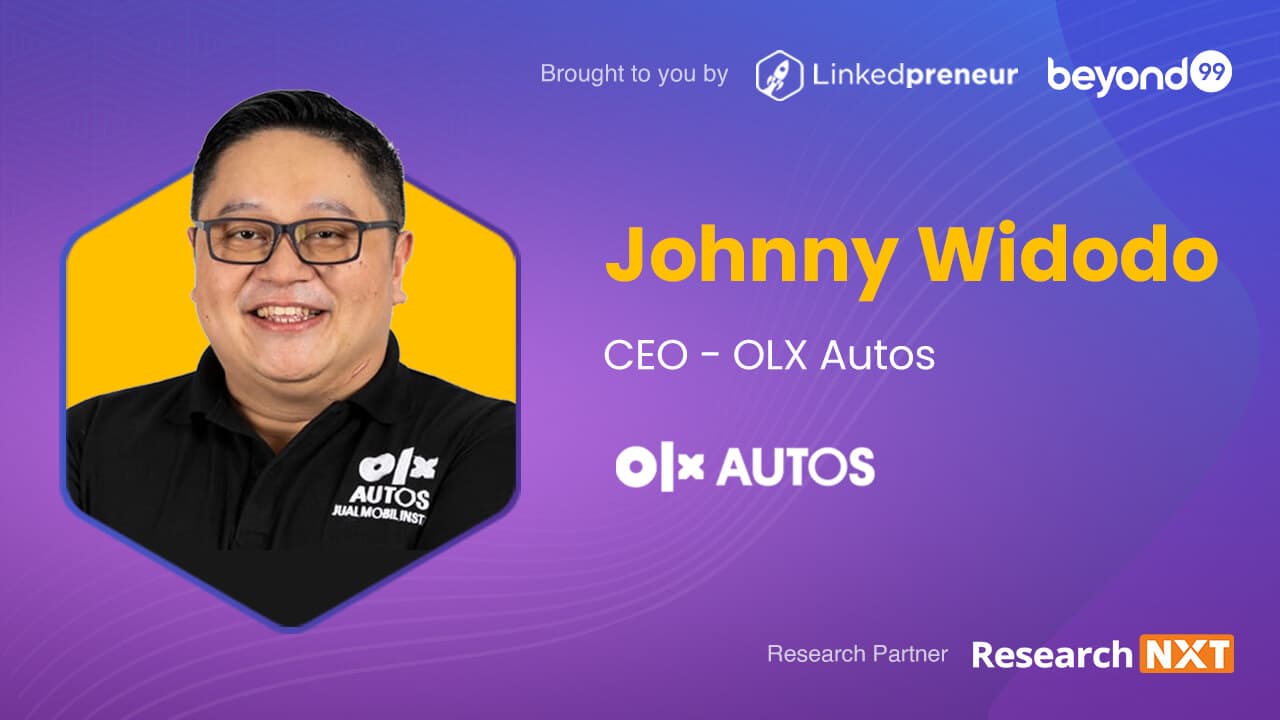
CEO of OLX Group Indonesia, Johnny Widodo, on business rebound strategies that businesses should adopt for facing the growth phase post-pandemic.
In this Research NXT interview, Johnny Widodo talks to us about the evolution of the digital-first industry since the pandemic started and how people's and businesses' behaviours have changed. He also discusses the trends emerging in the Southeast Asian markets in the new normal.
Key highlights
What this conversation covers
- The rapid acceleration of digitisation among businesses.
- Innovations launched at OLX Group in general and OLX Autos in particular, and by other automotive industry players.
- Critical steps to the business rebound strategy to be adopted by businesses.
The key is to put trust and peace of mind for the consumer as a priority by being transparent in the processes.
You have been very closely associated with multiple digital-first initiatives, OLX Autos being one of them. Could you give a brief about your journey and your current role at OLX Autos?
I came from an engineering background and started my career as an R&D engineer in Singapore for many years, and then I pivoted into more of a commercial role after my MBA from Nanyang Business School. I joined the consulting firm A.T. Kearney in Jakarta and spent a couple of years there, and then moved to the CP Prima group, one of the largest aquaculture companies in Southeast Asia. I was in charge of strategic planning, then moved on into the digital world. That was around five years ago when I became one of the founding members of Indonesia's largest digital payment business. I was employee number three and had multiple roles on the commercial side, sales, marketing, analytics, business development and operations, and spent close to four years there.
I then moved into another digital venture, BeliMobilGue.co.id, which is part of the Frontier Car Group based in Berlin that operates in 10 countries. I was the appointed CEO of that company for the Southeast Asia region. But at that time, we did not expand to any other country beyond Indonesia. It is a marketplace in the automotive business where people buy and sell their cars. I think I was there for approximately half a year, and then OLX Group added the investment in Frontier Car Group, and we were rebranded as OLX Autos. I am currently responsible for all OLX Group businesses in Indonesia, including classified and advertising from the OLX side, and convenient transactions and other new business lines from the OLX Autos side.
What are your observations on how the digital-first space evolved in the last few years? And how has it been affected by the current pandemic scenario?
There has been some phenomenal change. If I reflect, the pandemic started to hit Indonesia around the February to March 2020 timeframe. And that is when we actually started working from home and settled indoors. There are a couple of things that rapidly started accelerating during that timeframe, like the process of digitisation. People like me suddenly increased spending on online food delivery and stopped or reduced using ride-hailing platforms. There were a lot of behavioural changes. Suddenly people started to spend much time on OTT platforms and ecommerce platforms. So that is one, the behaviour changed.
Second, I think people in general became more conscious of their safety and hygiene. They minimised in-person interactions and started picking up a lot of new hobbies. During the pandemic, I have written two books; one is on how we can get through the crisis, which is very related to the topic today, and the other is about building a country through start-ups. I also started to do a lot of stuff on the J-Talk podcast, so in a way we all got more involved and accomplished a lot more than otherwise we would have. People also started paying more attention to their primary needs. For example, if someone wishes to buy a car, they start to think about other variables like whether they would keep their job or get the same amount of salary. I picked up all these points through our survey of potential buyers and sellers on the OLX Autos platform.
There has been a really strong shift in the thinking of the people themselves. However, on the other hand, if we look at the businesses, we see a couple of specific reactions. The business is forced to be more innovative in doing things, because at the end of the day if you are doing a lot of offline business you would probably struggle owing to the lockdowns. So, businesses have to pivot, and there are two ways to do it. One, either you innovatively focus on a different business like selling masks, protective hygiene products and everything connected to the crisis, or you start incrementally focusing towards the digitalisation of your business, putting assurance of safety and hygiene protocols in place so the business can go online. This is also one of the things that I shared in my book: for businesses to survive, they have to plan what they want to do and then grow the momentum through the whole cycle from start to finish. In essence, in the automotive business, we started to make sure that customers believe in our safety measures. We publish a lot of videos to educate people on how we are running the safety protocols, making sure that things are moving and that it is safe for them to come to the storefront. We also started to build innovative ways of selling cars. For example, previously customers had to come to our locations to do all the cars' inspections; however, now we switched the model, allowing them to get us to do all the required inspections while they stay at home. We send our representatives, who are thoroughly checked, sanitised, and in all the proper attire, to the customer location to inspect the vehicle. We also allowed our dealer partners to represent our brand and become the authorised dealers to sell the cars. We are also looking at helping the customers to sell directly to consumers through the platform. I know it is really hard to pick everything online instantly, but at the very least, the process of accelerating the changes has started.
One of the pandemic fallouts is that demand for used cars is surging as buyers consider budget-friendly personal transport to avoid public transport or even ride-sharing platforms. What are your observations regarding this? Are there new trends emerging in the Southeast Asian markets?
We see this, and by the way, this data is also available online: dealers sold around four to five cars per week on average before COVID-19. Then during the pandemic, it dropped to one or nothing at some point. However, we are probably running at around three to four cars per week in this moment of transition, roughly. So that itself tells us that we are at around 80% of the pre-COVID conditions.
Secondly, we also ran a survey with our potential buyers. And to your point exactly, the buyers are beginning to realise the need to buy their own cars instead of using public transport or ride-sharing platforms, to ensure their families' and their own safety. So, many people who planned to buy a new car now have concerns about the continuity of their income and buy a second-hand car instead. They are seeing where the economy is going. Another thing being considered is that 70% of people who buy a vehicle use financing options. And the financing companies are now taking more precautions in releasing their funds because of the fear of not recollecting the loans or repossessing the vehicles in case of another economic emergency. However, the good news is that in the past two to three days I have seen some news where the central bank has mentioned that there is growth of credit in Indonesia, and next year it is going to be about 7% to 9%, which is good. The macroeconomic indicators like GDP growth, inflation rate, US dollar exchange rate, and deficit are looking good. I guess for businesses now it is an upward trajectory.
Most businesses are innovating across business functions and diversifying their product and service portfolios, leveraging tech due to uncertain times and as part of their bounce-back strategies. What are your plans for OLX Autos? Are you contemplating adding financing and insurance options for your customers?
As mentioned earlier, we are trying incrementally to innovate with options like home inspection and our dealer franchising models. So we help our partners to make sure that they are still in the business and grow together with us, where we help them with deal assistance. And the most recent one is that we are going into the retail business.
In terms of innovating the business, one of the things that we are looking into, and hopefully it will be launched in the next couple of months, is the option of self-inspection of vehicles before selling. In this model, the seller would perform the vehicle inspections themselves and upload the details online for dealers or businesses like us to offer them a price. This moves from offline and tries to push the business as much as possible towards the online side.
Some businesses are trying to introduce the subscription model of owning a car instead of buying, as another option. However, the key is to put trust and peace of mind for the consumer as a priority by being transparent in estimating the price of a used car based on inspections. So, whoever can crack that will probably be able to win the market.
Thirdly, we as businesses need to leverage each other and graduate from being pure classified players to transaction players. Because at the end of the day, it is a more sustainable business model where volumes of transactions are higher compared to being just a classifieds business. We need to collaborate with convenience and retail stores and be a platform where volumes of transactions are higher.
What are your recommendations for businesses from a digital-first strategy considering the new normal? What should they consider in their business strategy while they are planning for next year?
This is exactly what is discussed in my book, but unfortunately it is not available in English. So, three steps should go into the strategy. One is basically to survive, the second is to plan, and the third is to grow. And that applies not only to businesses but also to the individual.
This pandemic will not be over soon, because we will have to test its effectiveness, distribution strategy, and many layers of questions once the vaccine comes in. So by every means, I would say even with the vaccine, we probably will need to live with it for the next few years at the very least. Hence, we will need to survive this. Businesses will need to think and prepare themselves to operate efficiently, and that is where digitisation comes in.
That does not mean changing overnight and investing a lot in digitisation. Businesses can start small and should only spend on what is necessary initially. The business will also need to continuously engage with its customers during this tough period to ensure presence in their mind. Customers will remember us when we genuinely help them during this period.
Secondly, when businesses start to plan, the focus should be on incremental innovation, incremental benefit, and incremental improvement on the current existing product, or switching towards a very new product. This is the best time for businesses to train people, get new people, and start building that digitisation mindset.
The next one is to have the vision to rebound by being prepared for the growth phase. Businesses will have to predict the path and market conditions, as everything will be on a higher trajectory as we advance. So that is how I see it.