From Tactical Support to Strategic Enabler: How Employee Transport Shapes GCC Scale, Trust, and Performance
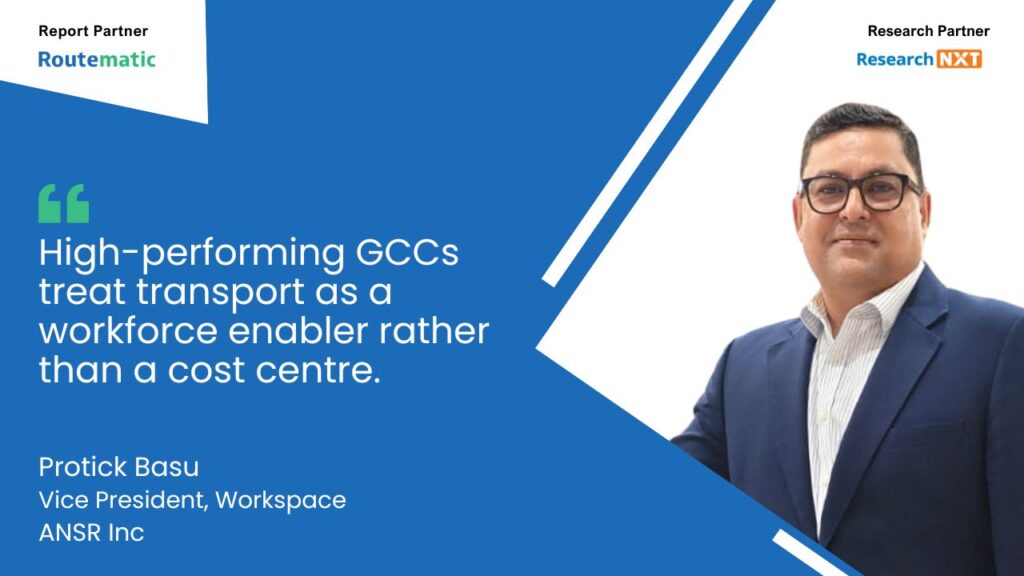
In this conversation with Research NXT, Protick Basu, Vice President, Workspace at ANSR, shares why employee transport has evolved from a support function into a strategic determinant of Global Capability Centre performance in India.
Drawing on his early career in hospitality and his current role overseeing pan-India workspace operations, Protick explains how predictability, safety, governance, and experience-led design in commute programs directly influence productivity, talent outcomes, and leadership confidence at global headquarters. As GCCs grow from small setups to multi-site, multi-shift operations, he highlights how transport readiness increasingly reflects the maturity, resilience, and credibility of India’s operations.
Key Takeaways:
- Commute predictability removes operational volatility and directly impacts productivity, shift readiness, and business continuity for GCC teams.
- Safe, tech-enabled transport experiences are now a decisive factor in talent attraction, retention, and employer brand perception in competitive GCC markets.
- Treating employee transport as a tactical function exposes organisations to safety, compliance, data security, and reputational risks.
- As GCCs scale, global leadership expectations move from basic reliability to governance visibility, audit readiness, and agility across hybrid work models.
- Cost effectiveness and strong vendor partnerships are essential to sustain transport quality without compromising employee experience at scale.
Could you share a brief overview of your professional journey and how it led you to your current role at ANSR?
Protick: I began my career in hospitality with the Taj Group, and that environment shapes how I still think about operations today. In hotels, service excellence, discipline, and customer centricity are not optional. One of the biggest learnings from hospitality is consistency. You cannot afford peaks and troughs. Guests expect the same experience every day, every hour.
Over time, I transitioned into real estate and workplace operations, taking on roles that allowed me to build and scale workspace operations for large enterprises. At ANSR, I lead pan-India workspace operations for multiple GCC clients across cities. Employee transport is a critical part of this responsibility because it influences how people start and end their workday. The hospitality principle of “first time, on time, every time” continues to guide how I approach transport operations, especially when designing systems that must scale without sacrificing consistency.
As GCCs scale in India, to what extent does employee transport readiness influence operational reliability and leadership confidence at global HQs?
Protick: Transport readiness plays a far more strategic role than many realise. For GCCs running 24×7 operations across functions such as finance, engineering, or cybersecurity, transport directly impacts business continuity. Predictable operations reduce absenteeism, ensure people arrive on time, and support stronger compliance controls.
From a global leadership perspective, these signals matter. When leadership sees that teams are consistently ready, shifts are stable, and governance is strong, it builds confidence in the India operating model. On the other hand, repeated SLA drops, delays, or safety issues translate into downtime and missed outcomes. Over time, that raises questions about operational maturity. In many ways, transport readiness becomes a proxy for how well India’s operations are managed overall.
Read More
How does commute predictability translate into measurable productivity outcomes for time-sensitive and shift-based GCC teams?
Protick: Predictability removes one of the biggest variables in daily operations. When employees arrive on time and without stress, productivity starts earlier. Teams are ready to work from the moment the shift begins.
Even small delays of 10 or 15 minutes start to stack up across shifts. Add to that vehicle breakdowns, safety concerns, or inconsistent routing, and you introduce distraction and fatigue into the system. A predictable commute leads to reduced stress and fatigue, higher on-time shift adherence, better team coordination across shifts, lower overtime costs, and improved customer satisfaction metrics. It allows employees to focus on work rather than logistics, thereby directly improving output and reducing operational noise across the organisation.
In high-competition GCC talent markets, how strategically significant is employee commute experience?
Protick: It is extremely significant. Most GCCs operate in large metros where commutes are long and unpredictable. The majority of the workforce is young, mobile, and tech-aware. Many employees have moved cities for these roles and live far from office locations.
For them, safety, predictability, and transparency during the commute are critical. When employees can see pickup times on their phones, track ETAs, and trust that the vehicle is safe and well-monitored, it builds confidence. Features like geo-tagging, panic buttons, and visibility into the entire trip matter, especially for women employees travelling late.
When transport works well, people talk about it. It strengthens employer brand, improves retention, and even influences offer-to-join decisions. When it fails, the opposite happens just as quickly.
What enterprise-level risks do GCC leaders tend to overlook when employee transport is treated as a tactical function?
Protick: Risk governance is the most critical aspect; a single incident can impact the employer brand, especially for women’s safety. Safety lapses expose organisations to legal liability and disrupt business continuity. Data security is another major concern, especially given GCCs’ sensitivity to information risk. Lack of visibility into employee movement or vendor data handling creates vulnerabilities.
Weak vendor handling of roster data, lack of visibility into employee movement, or poorly governed systems create vulnerabilities. When you combine safety risks, data exposure, and compliance gaps, it quickly becomes a reputational issue. In today’s competitive talent market, reputational damage can impact both employer brand and trust, making recovery very hard.
How do expectations from global leadership evolve as GCCs move from early growth to multi-site, multi-shift scale?
Protick: Expectations shift from basic service availability to enterprise-grade predictability. GCCs typically start small and then grow steadily. In the early stages, leadership seeks basic yet competent transport services. Consistency and reliability are the primary expectations.
As the GCC scales, the dynamic changes completely. Compliance requirements tighten, reporting expectations increase, and hybrid work introduces variability in attendance. Transport operations need to be agile enough to handle these peaks and troughs without disruption.
Over time, broader considerations like ESG, carbon footprint, and EV adoption also come into play. Transport is now discussed as part of the overall contractual agreement, alongside workplace design and operations. That shift alone shows how strategic it has become.
Do you see employee transport emerging as a differentiator between high-performing GCCs and those that struggle to scale sustainably?
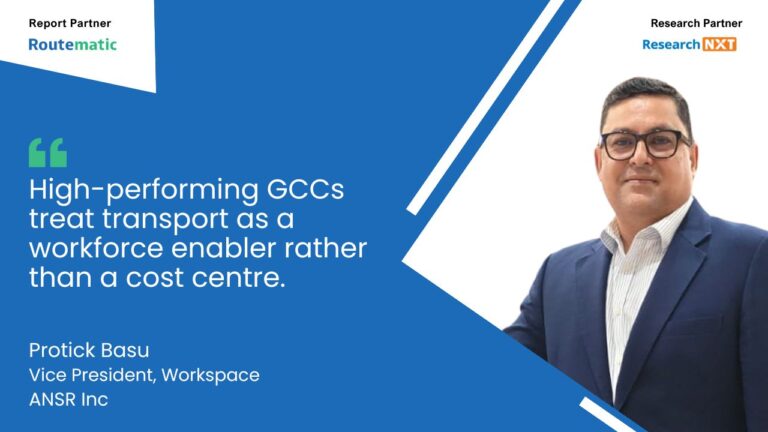
Protick: Yes, very clearly. High-performing GCCs treat transport as a workforce enabler rather than a cost centre. They use automation, IoT-based routing, real-time tracking, safety protocols, and data-driven planning. They understand that investing in safe, reliable transport delivers returns through increased productivity, improved employee well-being, and higher retention.
GCCs that struggle often face recurring compliance issues, safety concerns, and constant employee firefighting. That instability makes sustainable scale difficult. When transport is handled well, it supports stability, trust, and long-term growth.
What principles should leaders apply when designing employee transport to support long-term scale, resilience, and employee trust?
Protick: Safety must come first, followed by predictability and compliance, reliable routing, real-time visibility, and strong SLAs. Automation is essential to effectively manage scale, reporting, and governance. Experience also matters. If the commute experience is poor, employees will not trust the system, regardless of how compliant it looks on paper.
Scalability has to be built into the design from the start. Leaders should plan for growth from a small fleet to hundreds of vehicles without constantly redesigning SOPs. Cost effectiveness is equally important. If transport costs become unstable, future cuts often compromise experience and safety. Strong partnerships with transport operators help ensure consistency without cutting corners. ESG alignment, EV adoption, optimised routes, and reducing carbon impact. Leaders who build on these principles create an ecosystem that employees trust and the business relies on.
What would you like readers to take away from this report?
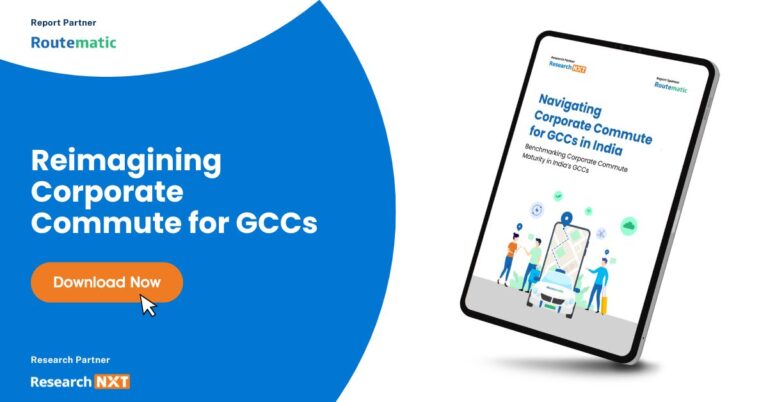
Protick: I believe this report should help GCC leaders understand transport not just as a logistical challenge but as a strategic enabler of performance, safety, and culture.
The report should help leaders understand where they stand today and how employee transport impacts real business outcomes. Benchmarking, governance frameworks, technology enablement, and risk mitigation will be particularly valuable. The most valuable insights would be those that highlight real-world benchmarks and maturity models, quantify the impact of commute predictability on business outcomes, provide frameworks for automation and technology adoption, address compliance and safety in a practical way, and offer actionable recommendations for scaling responsibly.
If the report helps leaders see transport as a lever for efficiency, talent retention, and global confidence, it will add enormous value.