Strengthening Corporate Mobility Through Governance, Technology, and Safety-First Operations
In this interview with Research NXT, Aditya Gupta, Head of Administration at NEC Corporation, shares insights from his extensive experience in hospitality, corporate administration, and large-scale operational management. The conversation explores how transport governance, compliance oversight, workplace safety, and cross-functional coordination come together to support employee well-being in a hybrid working environment. He also discusses the emerging risks shaping the future of corporate mobility, and the innovations that can help organizations build more predictable, compliant, and employee-centric transport systems.
Key Takeaways:
- Robust SLA-driven oversight — including regular inspections, detailed checklists, and penalty-enforced compliance — helps maintain near-zero lapses in transport operations.
- Night-travel and vulnerable commute scenarios are managed through stringent safety practices, including escorts and confirmed safe-drop protocols for female employees.
- Emerging risks such as EV fleet limitations, vendor dependency, and increasing cost pressures highlight the need for technology-led innovations like live compliance dashboards.
"We maintain detailed SLA clauses covering driver background verification, badge issuance, vehicle permits, fitness certificates, and GPS readiness."
Could you share a brief overview of your professional journey and how it led you to your current role as Head of Administration at NEC Corporation?
Aditya: With over 18 years of experience in Hospitality, Administration, and MICE, I have built my career around creating efficient, people-centric, and innovation-driven workplace environments. I began my journey in the hospitality sector in 2004, where I developed a strong foundation in service excellence, operations management, and stakeholder engagement. Over the years, I expanded into corporate administration and travel management, taking on roles that allowed me to streamline processes, enhance employee experience, and drive operational efficiency across large-scale organizations.
My ability to balance strategic planning with on-ground execution led me to opportunities to lead diverse administrative functions, including facilities, travel operations, vendor management, workplace safety, corporate events & Business Continuity. Along the way, I have worked closely with leaders to build systems that support business growth, ensure compliance, and improve cost optimization. Today, as the Head of Administration at NEC Corporation, I oversee end-to-end administration and travel operations, ensuring that our workplaces remain safe, efficient, compliant, and conducive to high performance. My focus remains on integrating innovation with risk management, leveraging technology to modernize administrative processes, and building environments where people can work productively and feel supported.
How standardized are your transport processes across locations and shifts?
Aditya: Our transport model varies by location. Full ETS services operate only in Noida and Bengaluru, while other offices run shuttle services connected to nearby metro and bus stations. Regardless of the service type, all ETS locations follow uniform SOPs across every shift, and standard transport protocols are consistently applied across all offices to ensure safety and operational consistency.
Read More
How do you ensure regulatory and internal compliance (driver KYC, permits, safety) across all locations?
Aditya: Vendor contracts clearly define statutory, regulatory, and safety requirements. We maintain detailed SLA clauses covering driver background verification, badge issuance, vehicle permits, fitness certificates, and GPS readiness. Compliance checklists are updated quarterly and audited by the admin team. We also conduct surprise inspections, enforce penalty structures for non-adherence, and require vendors to submit monthly compliance dashboards. This multi-layered governance ensures a near-zero tolerance for non-compliance.
What tools or audits do you use to ensure there are no lapses in daily operations?
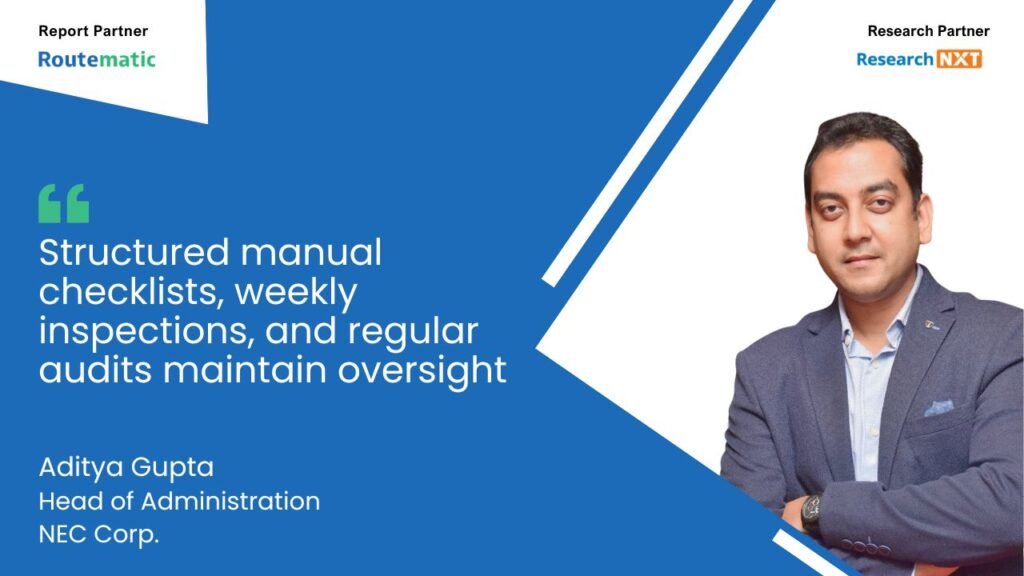
Aditya: Since we follow a hybrid working model across all locations, we rely heavily on structured manual checklists, weekly inspections, and regular audits to maintain oversight and ensure there are no lapses in operations. In addition to these reviews, we also conduct monthly training sessions for drivers to reinforce safety, compliance, and service standards.
How do you manage nightshift or vulnerable commute scenarios?
Aditya: At the moment, we do not have female employees working designated night shifts. However, on occasions where women need to stay back late and require a late-night drop, we ensure their safety by arranging escort guards and confirming their safe arrival home.
How do you collaborate with other departments (HR, Finance, Compliance) when updating transport or workplace policies?
Aditya: All policies fall under the purview of the Administration team. We conduct an annual review of these policies, and whenever updates are made, we communicate the changes to the entire organization through structured mailers to ensure clarity and alignment.
Where do you see the most significant risks emerging in the future?
Aditya: As EV adoption increases, it introduces new risks such as charging limitations, higher operating costs, and range constraints, all of which can impact service reliability. Additionally, the transport sector remains highly unorganized, creating significant dependency on vendor capability and consistency. In an environment where organizations are prioritizing budget efficiencies, balancing cost pressures with rising employee expectations becomes an increasing operational challenge.
If you had no constraints, what compliance innovation would you implement?
Aditya: If there were no constraints, I would introduce a fully integrated live compliance dashboard that consolidates all vehicle and driver information in one place. It would enable real-time tracking of every cab and provide automated alerts at least 30 days before any compliance document—such as insurance or pollution certificates—is due for renewal. This would allow timely action and significantly reduce the risk of non-compliance.
How do you measure the success of your transport compliance and safety strategy?
Aditya: We evaluate the success of our compliance strategy by closely observing the number of transport-related safety incidents, the nature and frequency of employee safety concerns, and the time taken to resolve escalated cases. In addition to incident tracking, we also monitor our compliance performance using detailed vehicle checklists and periodic audit results, which give us a clear view of operational consistency.
Are there any global norms your transport programme needs to follow?
Aditya: We adhere to global standards for employee data privacy, and our transport programme incorporates mandatory GPS tracking as well as safe-home-drop protocols for female employees working late.
We want to know your expectations from this report. What do you think would be most valuable for the readers of the report?
Aditya: I believe the greatest value for readers comes from understanding how structured governance, technology integration, and practical on-ground processes work together to create safe and reliable employee transport systems. Many organizations focus only on operational execution, but the real impact lies in establishing strong compliance frameworks, vendor accountability, and data-driven monitoring mechanisms.
Additionally, insights on managing emerging risks—such as EV readiness, vendor dependency, and rising cost pressures—will help readers anticipate future challenges and plan proactively. I also hope that sharing real examples of how we handle vulnerable commute scenarios, hybrid-work complexities, and multi-location transport models provides practical takeaways for leaders responsible for mobility and workplace safety. Ultimately, the discussion highlights that transport operations are not just a logistical function but a critical component of employee well-being, business continuity, and organizational trust.