In this interview with Research NXT, Lijo Mathew, Deputy Manager of Online Campaigns at The Indian Express, discusses his journey in marketing with a background in business development and digital marketing, gaining experience through various roles in different industries. His career has spanned business development, marketing research, demand generation, and now online campaign management at The Indian Express.
Key highlights
What this conversation covers
- Effective marketing strategies are built on high-quality data and tailored audience segmentation.
- Success in campaign execution relies on cross-functional collaboration, precise timing, and meeting client expectations.
- Using the right tools, optimising timing and frequency, and conducting thorough testing are crucial for improving open and conversion rates.
- Minimising email frequency for contacts involved in multiple campaigns helps prevent overwhelming them, while respecting unsubscribe requests is essential.
- Aligning marketing content with the audience's specific needs and interests is essential to driving engagement and campaign success.
It is crucial to ensure the subject line is directly relevant to the email's content, and to avoid any spammy-sounding keywords in the subject lines.
Can you share a brief overview of how you began your journey in marketing, what led you to this field, and how your experience has been so far?
I started as a business development executive through campus placement and interned at Aditya Birla Sun Life Insurance as a digital sales officer, conducting market research for a digital-only insurance product. This experience led to my first full-time job at a SaaS company for maritime colleges, where I combined business development and digital marketing, managing social media, email campaigns, and product demos.
At my next job as an assistant manager for demand generation at a sales consulting firm, I focused on lead generation through email marketing and webinars. My role involved ensuring good data collection, running email campaigns, and generating leads for the sales team. I quickly realised that email marketing alone was not enough to generate demand and close deals. I had to create buzz across other channels, connect with sales leaders of large organisations and build a community of sales professionals, our ideal target audience. I initiated webinars, a cost-efficient outreach method, starting with 50 attendees and gradually increasing to 150.
I learned one mantra from a colleague that I still hold close: any communication should follow the CSO format, challenge, solution, and outcome. We should keep things simple, for example text-based emails, avoiding lengthy content or heavy graphics. This approach, combined with A/B testing subject lines and optimising outreach timing, is crucial for improving click, open, and conversion rates.
In short, my journey has been a gradual learning process shaped by various roles, which has led me to where I am today.
You have moved across the spectrum from business development to marketing, focusing on solutions that are most critical to sales and marketing alignment in a space where time is a vital aspect. So, let us talk about your current role as Deputy Manager of Online Campaigns at The Indian Express. How has your role transformed here?
Media publication is a new direction in my career, as this is my first time managing campaigns in this industry. My role primarily involves managing a team to ensure campaigns are delivered effectively, leading to repeat business. We have a great team that has continuous knowledge exchange, and there is a lot of cross-functional collaboration. Given the size of The Indian Express, we have dedicated teams for email marketing, database management, social media, editorial, design, and more. My responsibility is ensuring campaigns run smoothly and meet client SLAs while liaising with clients for reporting and coordinating with external agencies for outsourced tasks.
Given your role in designing and facilitating campaigns for The Indian Express's clients across various channels, what channels are you deploying for your campaign strategies, and how do these media channels help in cross-channel integration?
I work with the business publications division of The Indian Express, focusing on Express Computer (for IT projects) and CRN (channel related campaigns). Our offerings include events, webinars, content syndication, and lead generation. For lead generation or content syndication campaigns with a targeted client-provided audience, we do not completely avoid social media channels but limit their use based on the specific needs of the campaign, as the outreach needs to be very specific to a closed list. We use segmentation strategies tailored to the campaign's needs, such as demographic, geographic, firmographic, and behavioural aspects, including audience intent based on cookie data.
Regarding the tools, we leverage various databases available in the market, along with our existing database and desk research data that we collate based on the campaign requirement. We also use our in-house CRM, and our campaigns combine both manual and automated approaches to ensure effectiveness.
We know email marketing is critical to your campaigns. Are you using an in-house CRM or specific marketing automation tools? Could you share some best practices that have driven your email marketing success?
Definitely. We run many email marketing campaigns through tools like Sendinblue and Elastic Email, which are integrated with our in-house CRM. We also use various other tools for prospecting, but so far email marketing has given us the most ROI.
Some of the best practices that we have developed after years of analysing what works and what does not could be broken down into the following buckets:
- Weekdays for selecting the campaign launch: We send many alternate-day emails; however, most of them are based on a test that we perform initially to understand which days of the week the campaign type works best. Based on our initial findings, we double-check the effective days before being assured of the same.
- A time that is most effective for open rates: We normally send our emails after lunch on weekdays except on Fridays, when we tend to use the time between 11am and 12pm. This is purely based on our experience of having a better response rate at these times on any given Friday.
- Use of corporate emails: Thirdly, though obvious, we stick to corporate emails for the campaigns as these are mostly B2B targets.
- Attempt and frequency based on campaign duration: We normally do not attempt more than four emails in any campaign. On the last attempt we also inform recipients that we will take them out of the campaign list, assuming they are no longer interested in the campaign's context. As for frequency, we generally wait seven days for the next follow-up unless the campaign duration is very short (four attempts in one to one and a half months). For a short-duration campaign, our follow-up frequency is three days.
- Experimenting with subject lines: This is an extremely critical exercise that should not be ignored. It is recommended to keep subject lines to 50 characters or less. More often than not, emails with the same subject lines to multiple recipients get tagged as spam or automated robotic outreach. It is crucial to ensure the subject line is directly relevant to the email's content, and to avoid any spammy-sounding keywords. Additionally, including a preheader along with the subject line helps build trust by giving recipients a preview of the email content. A/B testing your subject lines is important.
- Using multiple sender email IDs: It is advisable to use multiple sender email accounts to avoid landing in spam or junk mailboxes even after considering the above best practices.
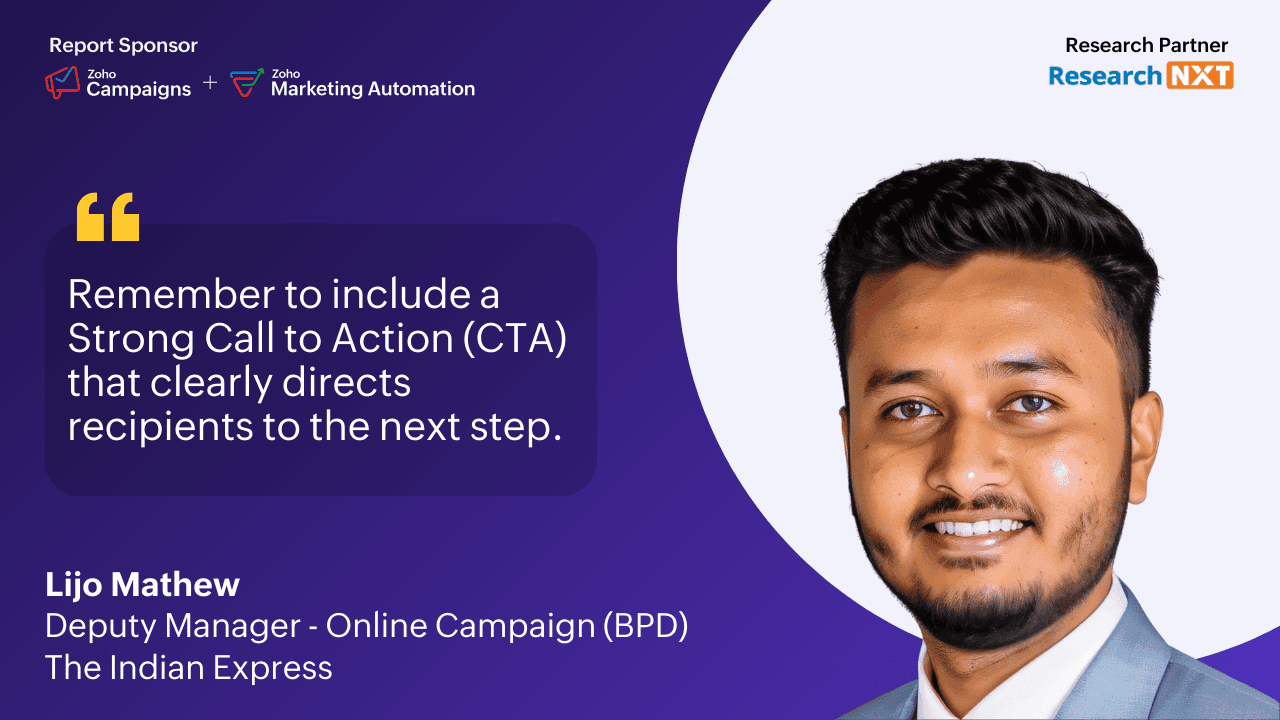
- Call to action: Do not forget to include a strong call to action which should clearly direct recipients to the next step.
You mentioned that the frequency of emails for a particular contact needs to be limited. Given that you manage multiple campaigns, which likely have overlapping data, how do you handle this overlap without overwhelming your contacts?
If a contact is eligible for, say, both Campaign X and Campaign Y, they might receive emails for both. To manage this overlap, we try to minimise the number of follow-ups for these contacts. For example, if I have ten contacts and five of them are also part of another campaign, I would identify these overlaps. Instead of bombarding these overlapping contacts with emails, I might limit the follow-ups to two or three emails at most.
We must reach out to them, there is no alternative, but we can manage the frequency to avoid overwhelming them. It is a tedious process, especially with large datasets, but we make an effort to do this. Additionally, we maintain a do-not-email list and strictly adhere to unsubscribe requests. If someone opts out, we immediately respect that preference and cease further contact.
You mentioned receiving content from different clients, often with overlapping target audiences. Have you noticed that one piece of content performs better than another for the same contact? Do you optimise content or provide insights to clients when you see one campaign working better than another, even when all best practices are followed?
The chances of promoting two products simultaneously to the same contact are very low. However, there are instances where two different clients might target the same audience but with different products. In such cases, it ultimately depends on the contact's interest. If they are interested in Product X, they will engage with that campaign, regardless of how beautifully crafted the email for Product Y is. It comes down to the relevance of the product to the contact's needs.
Even if the email body, subject lines, and overall design are executed flawlessly, if the product is not something the contact needs or wants to explore, they will not respond. Their decision is influenced by various psychological factors, including the specific needs of their organisation or personal preferences. Therefore, despite our best efforts in curating content, we have limited control over the contact's response.
The right content at the right time can significantly impact marketing. As a functional leader who regularly experiments with campaigns, what are your expectations from the report we are creating? What should we cover to make it worthwhile for someone like you?
My advice for anyone entering the marketing space is to be open-minded and adaptable. Marketing is constantly evolving, and what works today might not work tomorrow. Just because a strategy works for me does not mean it will work for you, but you can learn from the process. It is important to understand the campaign thoroughly, its goals, requirements, and the best medium for execution. Experiment with different strategies, and once you find what works, focus on getting the desired results.
Continuous learning is crucial. Read blogs, follow marketing experts, and stay informed about best practices, whether it is about timing, subject lines, or compliance issues like GDPR. There is a lot of valuable content out there, especially for B2C, but B2B marketing still needs more exploration. Use what you learn as a foundation, but always be prepared to adapt and innovate. My expectations from the report are to gain insights into various perspectives from marketers, including new methods and emerging trends.