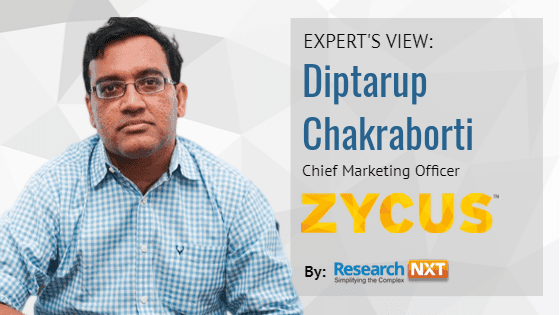
Diptarup Chakraborti is the Vice President, Marketing with Zycus, heading its global marketing and product marketing function for its SaaS based software products. He is a digital marketing expert with over eight years of experience in using digital, social and marketing automation platforms and tools to drive marketing ROI. Diptarup has extensive experience working for the overseas markets of the US, EMEA and Asia Pacific, along with India.
Your plan should be a living document and should evolve along with the evolution of your customers.
Zycus is a procurement service company, and your offerings are industry agnostic. How important is an ABM strategy for your organisation?
The way ABM is understood in the IT industry is that you have an existing account, and you try to increase the share of your wallet within the same account.
For us, an account comprises both existing accounts and prospective customers. It is about the entire journey which an account or potential customer takes with us, or along with our competitors.
We also try to map and target accounts that may have started their journey with Zycus along with our competitor, and then decided to go only with the competitor. They may begin evaluating after three years to renew their contract with the competitor, or look for some new vendor. So such accounts become our prospective customers. I need to be a part of every account's journey right through the life of the organisation, rather than be only part of the sales cycle. Hence ABM becomes very critical for Zycus.
How do you go about defining your key accounts to target?
The companies to which we can sell our solutions have to be at a certain technological maturity level. Small companies with a low technology maturity level, or where the cost of sales is very high, do not make sense for Zycus to go after.
The first segmentation which we do is to shortlist companies with revenue above $200 million. Then we have geographical segmentation, in which we do not include Latin America or African countries, as we have observed the technology maturity level is low and adoption is also very low. Once these broad categorisations happen, we map the customers into specific segments. We have had very little success in entities like government, federal, state government and defence. That is why we drop them from our target list.
After this primary filtration, we look at the employee size. A company could be $500 million in revenue but with fewer employees, and would not fit in our target list. Some parameters are subjective. For example, if it is a travel and tourism company, then it would not require a company like ours. Similarly, manufacturing, banking, oil and gas, or healthcare companies with $300 million revenue automatically become our prospects, as such companies feel the need for an automated procurement process.
There are multiple filters, and we evaluate about 20 parameters to define target accounts.
How are you leveraging marketing technology to get your campaigns right?
At the end of the day, a customer is a human being with certain behaviours and patterns. We use marketing technology to shadow them on their digital behaviour. We try to create a common room where they can all congregate, and target them with focused messaging. Once we have their persona, we target them with behaviour based messaging when they come online. These are some of the ways we use MarTech to remain close to our prospective customers.
Are you using any tool for tracking and analytics?
There are various tools that we are already using and some which are under investigation. I can name a few of them which we are using for ABM: Vidyard, Mintigo, AdRoll and Lattice Engines are some of the tools we are already using or evaluating for account based marketing.
Do you have any ABM best practices, for your industry or in general, which you would like to share with our subscribers?
The first best practice is that nothing is carved in stone. Always be ready to acknowledge that you could be wrong, and always be prepared to change immediately. The reason for this is that a customer is always evolving, so constant investigation is the need of the hour. You cannot have a static plan, and it should be reviewed quarterly. We have seen in the past that in a quarter, people change. Your plan should be a living document and should evolve along with the evolution of your customers.
The second is to get as much knowledge about your customers as you can. What I have seen people do is a little bit of Google or competitor analytics and create a persona which they want to target. But I feel it is extremely critical to know your customers more deeply. This can be done better by speaking to an analyst, and by primary and secondary research.
The third is to know what your competitor is doing. Let me give you an example. We have been investing a lot of money on LinkedIn and we are getting a good return on it, but over the period the cost per lead has gone up significantly. When we investigated further, we found that one of our key competitors has invested a lot of money in LinkedIn just for brand building activity. So now, to bid for the same keyword and the same target, we must shell out more money, which was not happening earlier. So knowing how a competitor is operating becomes critical, and you cannot operate wearing blinders.
The crucial fourth aspect is: do not restrict yourself to your industry. Try to gauge information from other industries, be it the consumer industry, or a service or entertainment industry. These companies could have a lot more budget than a B2B IT company, but they are doing a lot of ABM in their respective organisations. For example, Netflix has a massive amount of data and has been using that for marketing. There is no reason that you cannot take some of their learnings into your ABM strategy. We have done that and it has yielded positive results. I could never have the budget of Netflix, but I can have the practices of Netflix with my budget.
What should a marketer avoid while implementing an ABM strategy?
One should not go for a marketing automation tool without having a proper understanding of it. There are too many tools available in the market, and maybe due to pressure from seniors you could be tempted to use them. Later you might realise that you have underutilised them. The tech stack should be limited as much as possible, so that you can get the maximum utilisation of the tool. You should understand the product properly and not go for the next one before understanding the first one.
Secondly, without clear objectives and metrics, do not attempt anything. Do not have a programme without defining a clear goal.
Thirdly, do not have an ABM strategy without having a skilled team to manage and execute it. Usually we tend to get cheap digital marketing talent. I would say that we should pay more and get the right talent for the job. Never get less skilled talent to execute your ABM strategy.
From a technology standpoint, there is a lack of talent in India and globally who can execute a marketing strategy. How have you developed your team internally?
I would say presently we are not happy with it and are still at a work in progress stage. Zycus would not get the same kind of talent as Facebook or Reliance. What we do is try to get external help to train our team and send them to various conferences. We try to make sure that the person we hire is extremely eager to learn. What we have seen is that people get on board and they become happy with doing what is happening. We would like to have people who want to learn, change things, and can disrupt. If we can manage to get such people, the rest of the things can be managed to an extent. Obviously, if we can get both a very sharp mind and an extremely high degree of learnability, then nothing like that.
What are your expectations from the ABM Best Practices Report: India, 2018?
From the report, I want learnings from my peers on how they are facing the challenges and the ways they are overcoming them, how they are keeping abreast with fast changing technology, and also how they manage their digital budget for ABM, as they surely have other priorities as well. So if I can get some insight into their management of ABM budgets, then that would be great.